by E. Alan Meece
|
|
|
http://philosopherswheel.com/toccata.htm
This is an elaborate and detailed essay, always under construction, concerning my discoveries about Bach's Toccata in F and related subjects.
It explains in detail the thematic structure of the Toccata, its relation to other toccatas and to the toccata form. It explores the meanings of its structure in the
best possible way: by comparing it to vivid symbols deeply embedded in our culture and our own souls. It has lots of charts and pictures!
You can dip in and out and enjoy pieces of it if you like.
A lot of music that helps us experience, heal and release the spiritual kundalini energy of our 7 chakras is being created today; but Bach was there first!
It is also a key to all the esoteric mysteries: tarot, chakra system, kundalini, alchemy, astrology, kabbalah, the spiritual hero's journey, the medicine wheel,
sacred geometry and proportions, buddhism, sufism, and more; and even to science. Toccata in F is not only a great organ work; it is a map of the universe.
It also inspires my own map of consciousness and reality, the philosophers wheel.
Please update.
(See the second half of this essay that features The Tarot)
LINKS
Table of Contents
Illustrations and charts (many links here on this toccata page will open a new tab)
This site has been created for non-commercial uses only.
including articles by me and others on related subjects, plus footnotes, and You Tube videos of Toccata in F, other toccatas, Bach organ works, etc.
Share this page on facebook. Click on the icon below:
Share
The Toccata in F for organ by J.S. Bach, BWV 540/1, composed in about 1717-1722,
has been my co-favorite (with the other, much more-famous Toccata in D Minor, S. 565) for
decades. (Note: S. = Schmeider, compiler of BWV catalogue of Bach works.) I have played it more often than any piece since I first heard it in 1972. Starting in 1979 I taught myself to play the organ (instead of just the piano) by practicing this piece at the San Jose Unitarian Church. I played the first part so often, in which the F pedal is held down, that I wore out the pipe and had to sponsor a concert there to pay for fixing it.
But it only occurred to me in 2004, just before leading an informal talk and ritual at a Summer Solstice Celebration,
that this piece I have been practicing and listening to with rapt attention for years, is actually a picture of the chakra system. Now that I have made this connection,
it seems so obvious. Bach's Toccata in F is the most powerful and vivid musical experience of the chakras ever created, or that ever will be. And upon further reflection,
I have discovered amazing links to all the esoteric traditions.
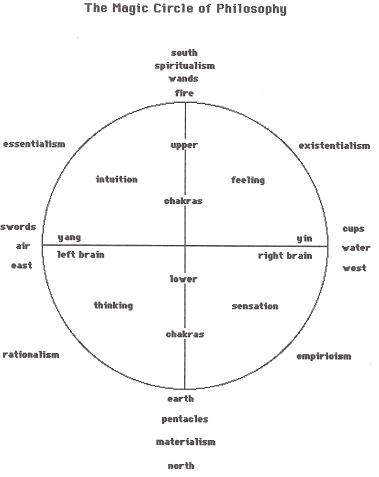
Since 1986 I have been developing the Philosophers Wheel, which compares all the great philosophy
traditions of humanity on a circle. I also noticed that the circle or wheel is used the world over to symbolize and contact the divine and the mystical or ancestral powers.
Then I saw that the chakras, the 7 main consciousness centers
along the backbone of the human body, can be compared to the "backbone" or vertical axis of this mystical circle. Finally in 2004 (when I was 54 years old), I made the connection between the chakras and Bach's Toccata in F Major.
What? Bach was into metaphysics, mysticism and esoteric philosophy? Is this a secret, hidden beneath the Christian symbolism so prevalent in his work?
He didn't necessarily intend this to be a metaphysical piece, but it doesn't matter. If you look a little closer, you can see it. If his music is as cosmic, symbolic and
mathematical as everyone says, then it should reveal this deeper level of spiritual truth; the esoteric or hidden level of religion that lies even within the story and
message of Jesus himself.
This Toccata is very metaphysically significant and symbolic. We know Bach didn't choose his inspired themes accidently! The Toccata in F reveals the essence of the esoteric sciences,
and putting them into music allows you to experience them deeply. This Toccata for organ is not only a cathedral in sound, it’s a musical map of the universe
and the patterns of life. I am continually amazed at how much there is to discover. I always felt something special about this piece, and now I know it is a true transformational
hero's journey in sound. It is musical alchemy;
a 7-stage stairway from earth to heaven. If as Robert Place says, this "now forgotten" story "
lies at the root of our culture" (The Tarot p. 4), and as Virgil Fox says
"from Bach all other music comes down," and given Lionel Rogg's description of this piece that matches the kundalini,
then this great cathedral in sound called Toccata in F truly evokes the very roots of our civilization. As we will see, you could even say "it's in our DNA."
Soundtrack to the Hero's Journey
|
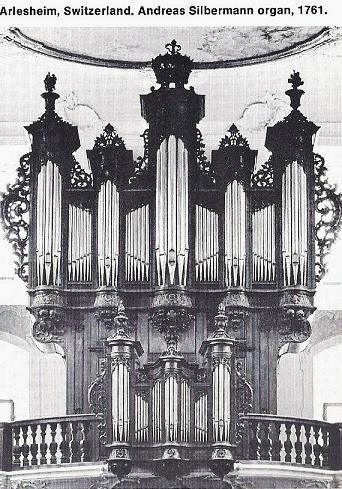
This piece is sometimes a bit repetitive. That's partly because an organ sounds just as loud no matter how hard you strike it. On a piano (a newer instrument developed in Beethoven's time) you can strike a key strongly or gently to make a louder or softer sound. That's why it's called a "piano-forte," which means soft-loud. Organ works create their effect on us with brilliant, beautiful patterns and structures. The varieties of possible sounds also help make up for the organ's lack of personal expressiveness. The exquisite tone of each pipe is crafted and voiced by expert builders, and three or more keyboards allow several majestic, elaborate melody lines to be played all at once by the hands and feet. Instead of the musician being the source of the sound, it flows as if coming down from heaven as air is pumped through the pipes. We hear each sound when a key opens one of the pipes to the ever-flowing current. Using all these capabilities of the organ to the utmost, the Toccata in F rises like a majestic structure from a vibrant, idealistic, joyous theme, through an ambitious, grandly-expansive and elaborate (if somewhat repetitive) development, to a visionary, crowning climax. It sounds like a concerto or a symphony. Its spacious attitude reminds me of Beethoven’s F-Major Symphony, the Pastorale (the sixth). Like Beethoven's Fifth Symphony too, everything is formed from the original germ, according to organist Lionel Rogg, who performed the most definitive version of the Toccata in 1970 at Arlesheim Switzerland (on the organ at left). |
| Hear it in the video at left. |
A toccata is a virtuoso piece usually written for keyboard. The name means to touch, meaning to touch the keys.
It is a musical form which (according to Lionel Rogg)
Bach shaped and perfected in this Toccata in F S. 540 (and which Bach evolved through its predecessors, his famous d Minor S.565, whose "fugue" actually
resembles the later toccatas more than its "toccata;" then in C major S. 564, and in the Dorian mode S.538). Bach's toccatas in turn influenced most of the
toccatas that came after him. A toccata is not really like a symphony or a sonata though. It does not develop themes in the same way, because it is peppered with
rapid running passages and repeating chords. Many listeners appreciate the lively, vibrant brilliance and perpetual motion that the toccata form as perfected by
Bach in this work expresses. It may even remind some listeners of today's European style of electronic music, or even techno/electronic dance music.
Such composers as Schumann,
Chaminade,
Prokofiev, and the
modern French organ composers created brilliant toccatas based on Bach's organ Toccatas.
Rogg defines "toccata" for us here.
See LINKS to hear many examples of these toccatas, and verify Rogg's insight that they were influenced by
Bach's (especially S. 540).
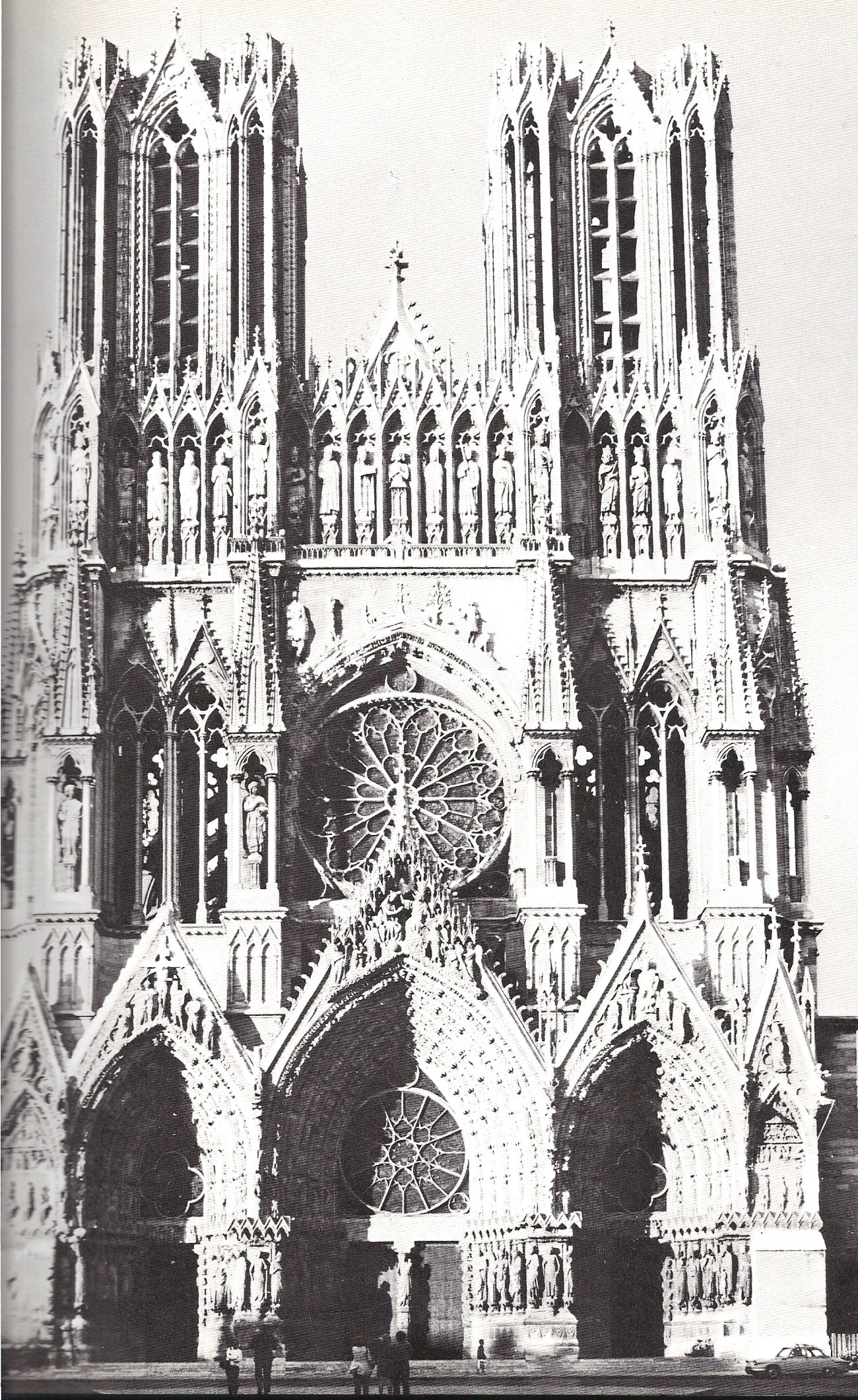
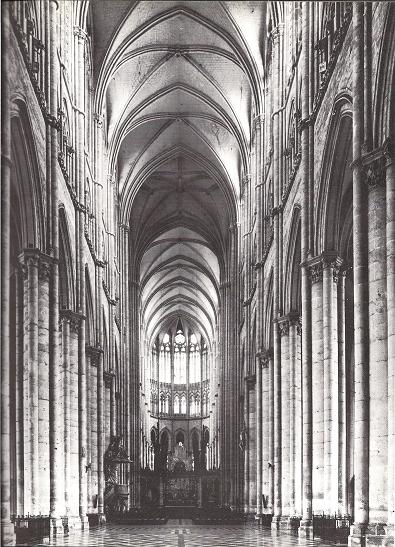
Rogg compared the Toccata in F to the building of a cathedral. As we'll see, it's also like the building of kundalini energy in our own bodies, our temple of the spirit. It builds, develops and ascends through 7 levels toward a climax, just like the practice of kundalini. The grand chords and "motoric" running passages of the toccata take you on a journey to ever higher places, giving you ever-grander scenic views. It is a wondrous sonic adventure. Upon hearing (and playing) the climax at the end, composer and organist Felix Mendelssohn declared, "It sounded like the church was going to collapse. What an awesome cantor Bach was!" It has been called "apocalyptic" and "monumental."
On the left is the facade of Reims Cathedral, and on the right is the interior of Amiens Cathedral
|
|
Notice how this greatest of cathedral facades at Reims has 7 levels, with the fabulous rose window in the center; see the heart shapes on it? Oh, and the heart chakra is supposed to have 12 petals!
Whenever I think of "what is the purpose of my life," I think of Bach's Toccata in F. It speaks to us of bringing something great into the world. It represents how life itself came into being, which is said to have evolved in 7 stages; like moving up the chakras. Of course, as spiritual or religious music, it expresses how God creates or manifests the world. For traditional Christians, that's the 7 days of creation, which on the esoteric level is the basis of the kabbalah. But Bach's F Major has a visceral appeal too. It grounds the listener deeply; and at the same time calls you to aspire toward the heights-- and then takes you there. Afterward, in the fugue, you continue to float. As Virgil Fox put it, "you can ride to another plateau with Bach."
While listening to it back in the 1970s and 80s, I could picture in my mind a renaissance blossoming in the arts and spirituality unfolding around me while listening to this Toccata. Back then, it still seemed possible, because of the new spirit and music emerging. Partly inspired by Bach's Toccata in F, I put together the New Age Renaissance Fair (1982-1997), an expo based on the premise that a renaissance was happening; meaning new inspiration, creativity, and above all the conviction that we can do great things of lasting value; especially in the arts and (as Bach would say) dedicated to God's glory. Such a Renaissance doesn't seem so plausible today, in a world still focused above all in money and technology, which are at best only means to these greater ends. But the Toccata in F represents those moments when we feel that such a rebirth might still be possible.
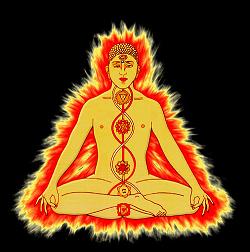
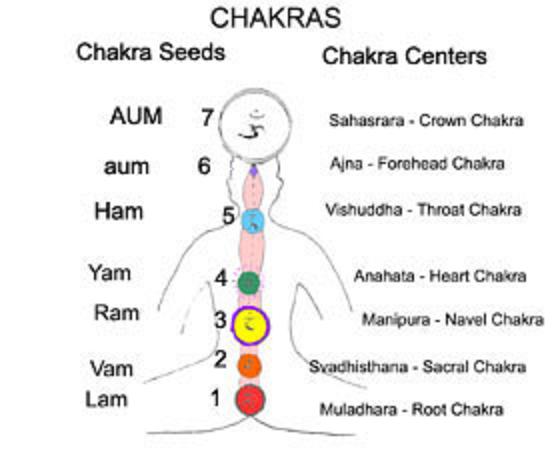
The Chakras are 7 places along the spine of our own body that we experience as 7 major centers of energy, corresponding to the 7 endocrine centers and 7 nerve ganglia of the body. The Hindus developed the yoga system of kundalini to arouse and liberate each part of us. The physical and sexual energy of the lower chakras is raised to the higher ones, leading to blissful enlightenment. It is often described as the female goddess Shakti rising to find union with the male god Shiva. The chakras are seven steps to enlightenment.
In each center we can feel the different energies and abilities we need for life. When we are centered in each chakra, and the currents between them are flowing, each functions at its highest level. Then enlightenment and insight (and not just ordinary, runaway thinking) happens in the upper chakras, and success in the physical world (and not just runaway fear and indulgence) happens through the lower chakras. Connecting to the heart chakra in the middle balances the chakras so you can express your authentic, loving self. All 7 chakras are good places where we can center ourselves. You can connect to each chakra from lowest to highest as you move through the 7 main sections of Bach's Toccata in F. Here are the aspects and faculties of our being related to each chakra, listed from the highest:
|
|
*Accounts differ regarding this gland correlation, but this seems to be the consensus, even though the pituitary gland is actually located closer to the eyes than the pineal. They may also be the yin and yang sides of the 6th chakra. Some say enlightenment or intuition results when these sources of "milk and honey" (silver and gold) are joined. Rick Richards is one who correlates the pineal with the crown chakra, and says both the 6th and 7th chakras, and both the pituitary and pineal glands, must be active before we can see through the third eye. The pituitary is the gland that controls all the others. Also see All Good Things
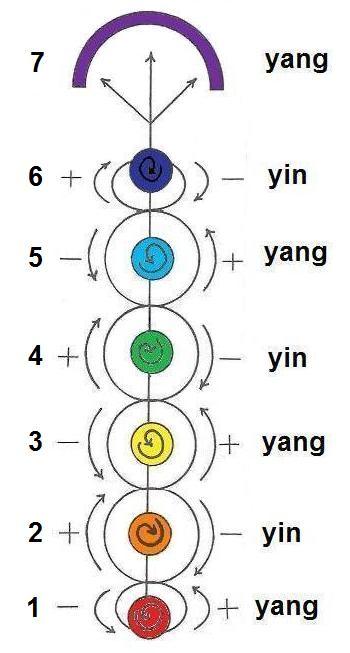
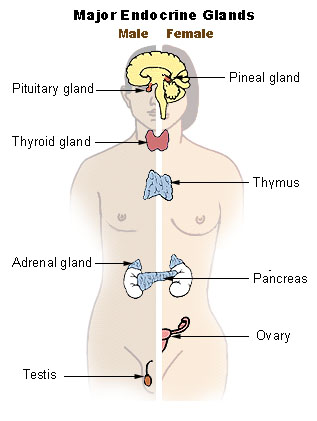
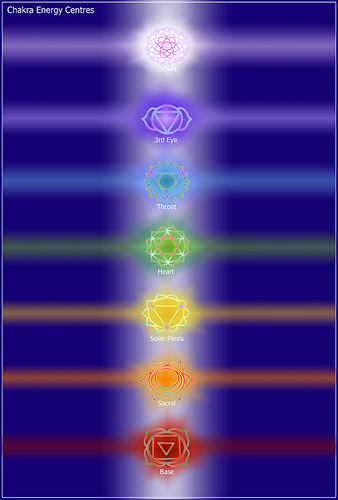
The picture below shows the polarity and color of each chakra, according to Anodea Judith. The base, Chakra One, is at the bottom (red); and the crown, Chakra Seven, is at the top (purple). Yang chakras are more assertive; yin more receptive. Chakras alternate between yang and yin as you move up or down. The word chakra means wheel; they are vortices of turning energy. Yang chakras turn to the right, the yin chakras to the left. As shown in the charts below, the yang chakras 1,3 and 5 correspond to primary colors red, yellow and blue, while yin chakras 2 and 4 correspond to secondary colors orange and green; until we get to the 6th chakra (2nd from the top), which corresponds to the tertiary color indigo, while the yang 7th chakra corresponds to the secondary color purple. These are the colors of the rainbow delineated by Newton, which may be why Anodea Judith calls the chakras the "rainbow bridge from earth to heaven." Those who can see auras most often report that the chakras show these colors when healthy. To the right below is a diagram I found of the glands that correspond to the chakras. They also are arranged according to male (yang) and female (yin).
| 
|
In 2004 it occured to me that, since the Toccata unfolds in seven distinct upward-moving phases, it is an audio
picture of the seven major chakras. A grand canon (imitation) theme opens the piece, just like the double helix of kundalini.
Then (after a pedal solo) we hear a majestic chord that decisively ends the first section. Then a second canon starts, and this section ends
with a whole bunch of powerful chords. The third section is launched by the Toccata's second theme, a powerfully-uplifting arpeggio.
This theme returns to mark off and open each succeeding chakra section, including the seventh, where it is transformed into a stunning, blissful climax.
As we move up the Toccata from its auspicious beginning to its
crowning glory, we hear the first two sections in which the two hands each play long lines of notes that imitate each other, accompanied by a
held-down pedal note (called an organ or pedal point); each time followed by a pedal solo.
In the next three sections, hands and pedal together play a powerful uplifting theme alternating with the original theme.
in the last two sections the themes are gloriously transformed, taking us to the top of the chakras (or the mountaintop, cathedral spire,
cosmic consciousness, etc.). Each is an increasingly magnificent "peak experience" like students of kundalini yoga might have, releasing spiritual energy.
This 3-part arrangement is just like how Anodea Judith arranges the chakras in 3 parts: two base chakras, and two upper chakras,
with three in between (see Wheels of Life, p.46, 183). Judith links these three groups with the Hindu gunas, the first two with tamas (denseness),
the middle three with rajas (passion), and the highest two with sattvas (wisdom, expansion); although the heart is considered both rajas and sattvas
(indicating the wisdom and balance of the heart).
These are the same three parts of the soul mentioned by Plato, the
Kabbalah and Freud. Robert Place showed how the
21 tarot trump cards (the so-called Major Arcana) tell a 3-stage hero's spiritual journey, and he compared them to Plato's 3 part soul, and to the Joyful,
Sorrowful and Glorious Mysteries of Christianity, often recited in rosary prayers, describing Christ’s journey (The Tarot: History, Symbolism, and Divination, p.128).
These are mysteries Bach himself probably knew about. The Joyful stage was Jesus' incarnation and early life (when he was a carpenter), the Sorrowful stage was his
trials, passion and death, and the Glorious stage is Christ's resurrection and ascension. The story of Jesus, so familiar to Bach, is indeed a prime
example of a spiritual hero's journey, which the Toccata in F symbolizes in sound.
Examining Bach's Toccata in F more closely, we find not only 7 sections, but
we see that each section in turn has two parts. The last two sections are somewhat shorter than the other 5, so
they are also a division of one larger section. Thus, 6 sections, and 12 sub-sections.
So these two sub-sections for each chakra corresponds to what Anodea Judith has described (p.118 and 121) as the two currents in each chakra,
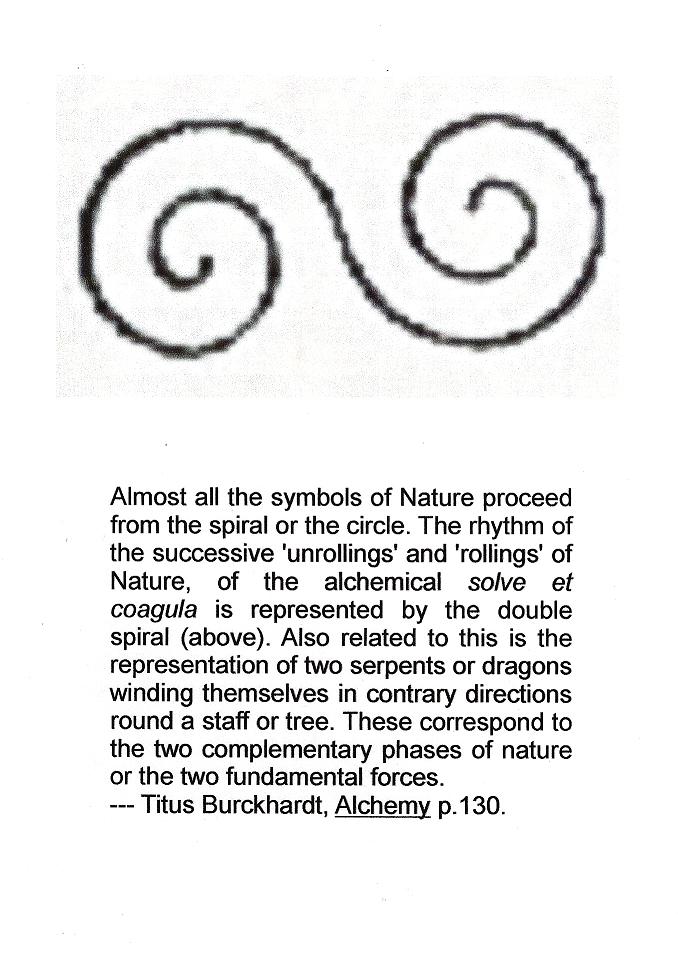
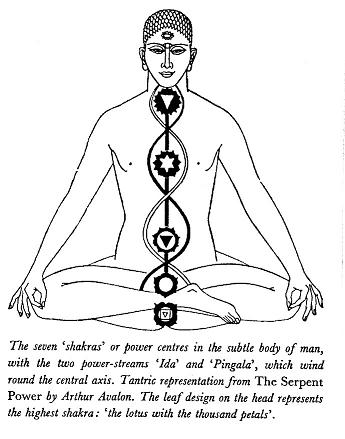
one flowing upward from below, and one downward from above. The Hindus represent them as two snakes (Ida and Pingala) which wind or spiral 6 times around the
backbone axis (the Sushumna, or the staff of the caduceus), and around each chakra
(illustration at left from Alchemy by Burckhardt). The two opposing currents around each chakra cause them to "spin," and by switching their position
between left to right from one chakra to the next, the currents cause the chakras to alternate their direction of spin. So there are 12 positions in the chakra system,
just like in the toccata; two for each chakra (except the crown), as the two currents pass up and down on each side of each chakra.
At 3:30 in this video, notice the two currents that cause the chakras to spin like gears.
These 12 positions in the chakra system correspond to the 12 signs of the zodiac.
In kundalini we move up and down the chakras in the same pattern as we move through the signs each year.
What this means is that the zodiac is in your own body. As you move through the chakras, you also move through the signs, and as you listen to the
Toccata in F, you move through the signs as well as the chakras. You hear the cosmos reflected within yourself as you hear Bach's cosmic music.
The Toccata in F is truly the "music of the spheres" as envisioned 2600 years ago by Pythagoras, the first philosopher to compare music to the planets,
as a stairway to the heavens, and also the first to compare music to the soul centers or chakras, our own internal "stars" and "stairway." (or star-way)
We alternate through yin and yang signs each year, just the same way we move through the chakras.
Each succeeding sign changes polarity from the preceeding one. Thus Aries is yang (positive polarity), the next sign Taurus is yin (negative polarity),
Gemini is yang, Cancer is yin, and so on. So the "current" of energy through the yearly cycle of signs and seasons alternates back and forth
in the same way that the chakras do. Also, as we move from the dark and cold of Winter to the bright light of Summer, and back, so also in kundalini we
move from the darkness of our base chakra up to enlightenment and bliss in the third eye and crown, and back again.
Furthermore, each sign of the zodiac is linked to one of the 7 visible planets ("the spheres").
This is called rulership. We are moving up and down the "ladder of planets" as we move through signs and chakras.
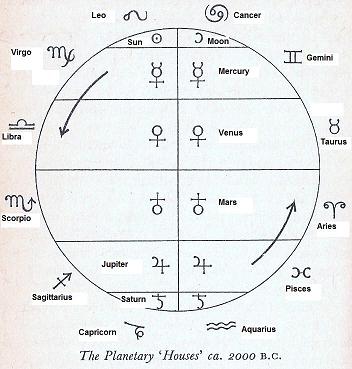
The 5 visible planets each rule two signs of the zodiac, and the Sun and Moon rule one sign each. This pattern was discovered around 2000 BC,
when the Summer Solstice occured as the Sun entered the constellation Leo.
This diagram from Titus Burckhardt's book Alchemy (page 88) shows this pattern
(labelled by me, in case you don't know the symbols).
As you can see, a whole pattern is formed among the visible planets in astronomical order,
like a ladder from the outermost planet Saturn at the bottom of the table to the Sun and Moon at the top.
Each planet rules both a yin sign and a yang sign, one from each side of the year, from Winter to Summer,
or from Summer to Winter.
Just like the chakras, this pattern has 7 levels, with the top level divided into the signs ruled by the brightest two "planets," Sun and Moon.
Therefore, as the mystic sage and scientist Pythagoras discovered, each of the 7 planets corresponds to one of the 7 chakras. Both also correspond to the
7 notes of the diatonic musical scale, which is why he called this harmonious pattern "the music of the spheres."
The signs ruled by Saturn represent the base or first chakra (Aquarius the positive or yang sign, and Capricorn the negative/yin, each ruled by
Saturn), the signs ruled by Jupiter represent the 2nd chakra (Pisces the negative, Sagittarius the positive), the signs ruled by Mars represent the third (Aries positive, and
Scorpio negative), Venus the fourth (Taurus yin and Libra yang), Mercury the fifth (Gemini yang and Virgo yin), and Moon and Sun represent the 6th and 7th respectively,
ruling one sign each (the Moon ruling the yin sign Cancer, and the Sun ruling Leo the yang sign)-- just like in the Toccata, where the two shorter
final sections can also be considered two halves of the final section, and just as the pituitary and pineal glands are on the same level in the brain.
By the way, it's appropriate that Leo should represent the crown theme, since the Lion is the "king of beasts" and kings wear crowns.
Whatever we may think about whether the Leos we know are actually wise in their regality, or just arrogant, the sign of the Sun is archetypally the sign of the
crown chakra and its wisdom.
The seven levels of the chakras with their yin/yang polarities are seen in other systems of thought and patterns of nature. For example:
See a chart of the 7 levels here, showing a few patterns and how they align with the 3 parts of the soul.
just as the primary colors represent yang chakras, and secondary colors the yin;
just as tonic and dominant tones represent yang chakras (tonic C, E, and dominant G; plus B), and intermediate tones D, F, and A the yin.
You can also use the 5 main English vowels to bring the spirit downward. I like to tone without combining two sounds, so the flow is not obstructed;
such as plain uuuuuu for long U, instead of EEE-YUUU; or ah-ah-ah for short a, instead of long I (ah-EEE). First take a deep breath.
Then you can start at the sound center itself (the fifth chakra) with long A (without the EE sound on the end). Move up next to the higher chakras with long E,
and then down to the heart center with the ah-ah-ah sound (long I = ah-ah without the EE after it), relaxing into the center of your soul.
Then tone long O to open your power center, and long U (ooooo) to stimulate and ground your soul in your lower chakras.
If you have perfect pitch, you can tone in the appropriate key for each chakra, using either method; or use the notes from the basic 7-note Toccata in F themes
as you slowly go up the 7 chakras.
Manifesting portions chakras Liberating portions crown theme 7-crown & 6-third eye
synthesis of themes snake theme 5 5-throat upward liberating theme 3 snake theme 4 4-heart upward liberating theme 2 snake theme 3 3-navel upward liberating theme 1 pedal solo 2 2-sacrum snake theme 2, left hand leads pedal solo 1 1-base snake theme 1, right hand leads
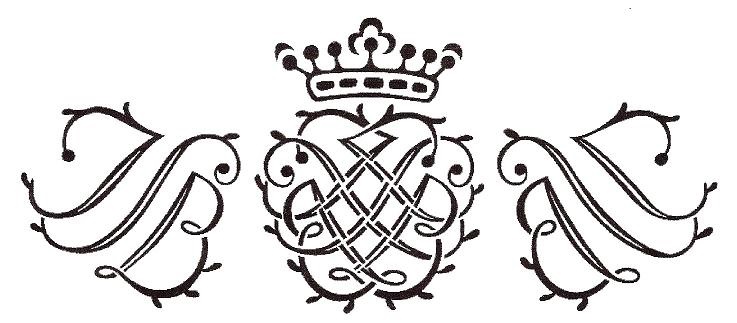
The orange line in the center of Bach's seal here represents a scroll bar guiding us through Bach music videos on this you tube channel. But intentionally or not, it makes our point. Bach's signature seal is the chakras:
The Chakras and Astrology: The Music of the Spheres
sign polarity ruling planet polarity sign Leo yang Sun/Moon yin Cancer Virgo yin Mercury yang Gemini Libra yang Venus yin Taurus Scorpio yin Mars yang Aries Sagittarius yang Jupiter yin Pisces Capricorn yin Saturn yang Aquarius
With the yin/yang alternation added, you get the above pattern
Toning the chakras with the toccata pattern in mind:
Seven of the vowel sounds also run up the chakras in the same way, with long sounds evoking the yang chakras, and short sounds the yin chakras;
Tune up your chakras!
Toning is a simple way of musical meditation that can attune your own body and soul to the harmony of creation. You can open your chakras and
tune into their liberating power and inner wisdom by toning the sound indicated in the table for each chakra, moving upward as listed above.
Remember "The Witch Doctor"? You can connect your base, crown and heart chakras by chanting "OOO, EEE, OO AH AH!"
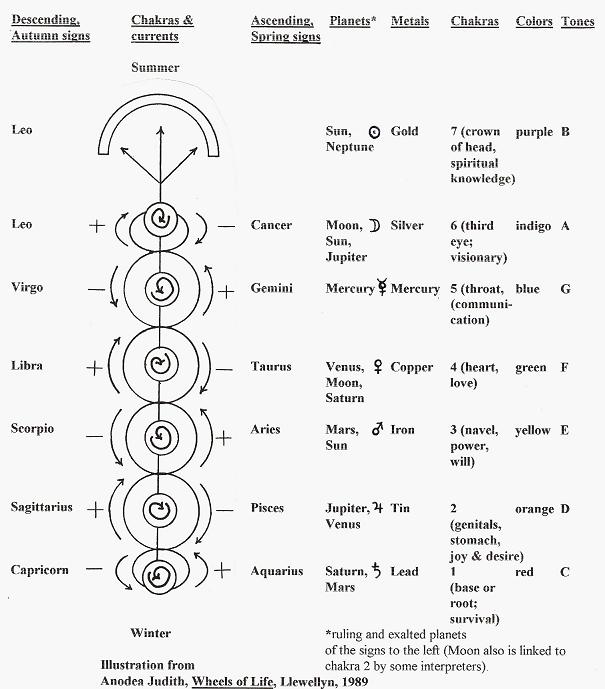
Here is a chart showing how the signs of the zodiac correspond to (and even generate) the two energy current channels Ida and Pingala
(or the two caduceus snakes), as they alternate between yin and yang
(or negative and positive) through the yearly zodiac cycle.
The cycle starts with the southern Winter signs (Capricorn, Aquarius) at the base chakra, moves up through the Spring signs, to the northern Summer signs
(Cancer, Leo) at the crown chakra, and returns through the Autumn signs to the base.
| chakra | Autumn signs | Planets | Spring signs | chakra |
| 7-crown | Leo | Sun/Moon | Cancer | 6-third eye |
| 5-throat | Virgo | Mercury | Gemini | 5-throat |
| 4-heart | Libra | Venus | Taurus | 4-heart |
| 3-solar plexus | Scorpio | Mars | Aries | 3-solar plexus |
| 2-sacrum | Sagittarius | Jupiter | Pisces | 2-sacrum |
| 1-base | Capricorn | Saturn | Aquarius | 1-base |
Each chakra is ruled by a planet, which in turn rules (is linked to) two signs each, one yin and one yang; except the Sun (yang) and Moon (yin) which rule one sign each. With the planets in the center, their two ruling signs are shown on each side of them. Yang signs are in bold and red, yin signs are in italics and blue. The ascending, liberating, yin Ida current or "snake" flows through the yin signs, and the descending, manifesting, yang Pingala current/snake flows through the yang signs, each current switching from side to side at each level. Although to my knowledge this scheme has never been presented before, it is a combination of the illustration by Anodea Judith from Wheels of Life (1989, Llewellyn), page 123 (shown under "chakras and currents" in the next chart below), and Titus Burckhardt, Alchemy (1960, Penguin), page 88, shown in the picture above. By the way, sometimes the liberating current is described as yang and the manifesting as yin.
Which direction each chakra turns MAY depend on which way you look at the body. In the chart below, the yang chakras (1,3,5,7) turn counter-clockwise; but in the video above, yang chakras turn clockwise, which seems more in accord with magic practice if the manifesting current is yang. Anodea Judith says that the word chakra means "wheel" (which spins), derived from the wheels of the chariots of the invading Aryan rulers of India.
|
|
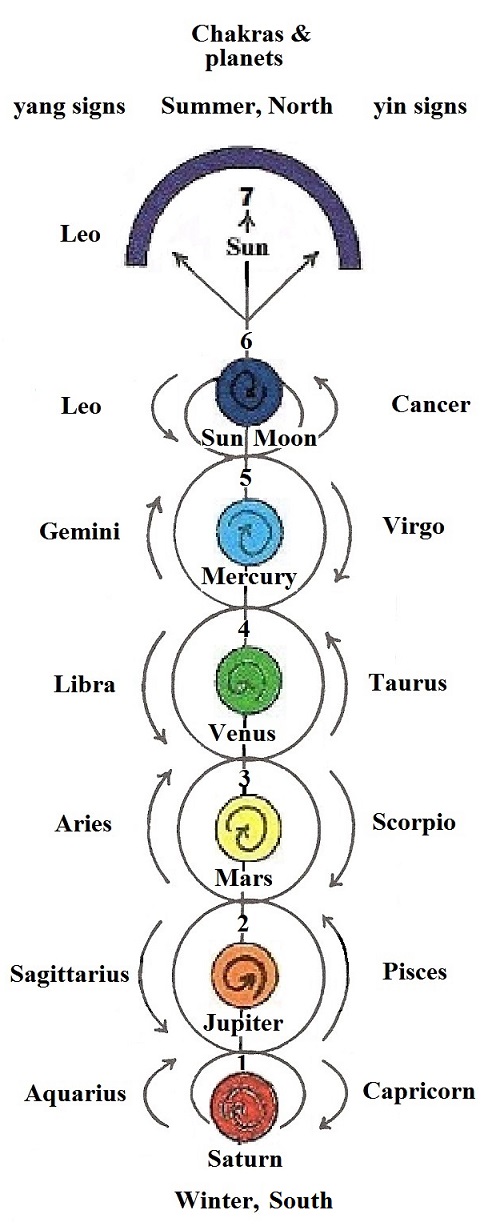
You can also correlate the chakras and the signs in an alternative way, putting the yang signs on the right and the yin signs on the left (or vice versa works too). Then the yang signs and the yang chakra current are on the East of the Medicine Wheel, and the yin signs and yin current on the West, and on the columns of the kabbalah's Tree of Life right is yang and left is yin. In these symbols, yin and yang do not switch sides at each level. In this arrangement you move side to side through the signs instead. The spring current starts with Aquarius on the right (yang) and continues switching back and forth as it moves up to Cancer at the top of the chakra tree. The autumn current starts with Leo on the right (yang), and continues to switch as it moves down to Capricorn. In this 2nd symbolic scheme, each chakra wheel still switches direction as the currents ascend and descend:
| yin signs | PLANET | yang signs |
| Cancer (spring) | MOON/SUN | Leo (autumn) |
| Virgo (autumn) | MERCURY | Gemini (spring) |
| Taurus (spring) | VENUS | Libra (autumn) |
| Scorpio (autumn) | MARS | Aries (spring) |
| Pisces (spring) | JUPITER | Sagittarius (autumn) |
| Capricorn (autumn) | SATURN | Aquarius (spring) |
Footnote: click here for a footnote on alternate views of this kundalini pattern
(this takes you to the footnotes and LINKS page)
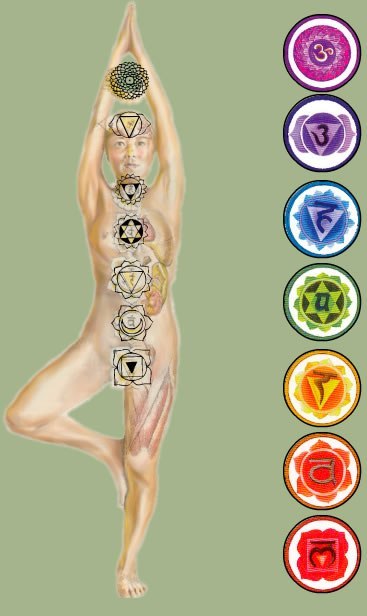
Here are three more chakra illustrations:
|
|
|
Get a copy of the piece if you can, or click on one of the performances available on You Tube:
Dan Campolieta performs it (above)
https://youtu.be/-6bf1UM5e18
Karl Richter performs (above)
You can follow the essay and the music together. Just click on the embedded video for each chakra below.
Or click on a You Tube link here and switch between tabs. Click the pause button whenever you need to stop the music, to give yourself time to read the description of each relevant section.
Chakra OneIntertwining spiral snake theme turns the chakra wheel clockwise
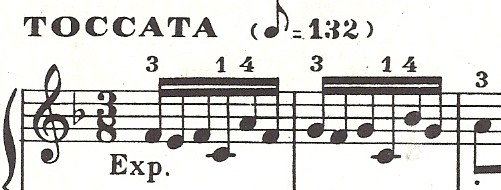
The Toccata in F begins with a long, snake-like linear string of notes played by the hands. The theme itself consists of 6 notes per measure (the 1st 6 chakras), with this 6-note figure then virtually repeated in the next measure one note up the scale, to form a total of 12 notes. The 1st note of the next bar can also be considered the 7th note of the previous bar (thus, the 7 chakras!). In the first two bars, there is one note for each sign of the zodiac, which is also one note for each position of the chakra currents, and one note for each of the 12 half-sections of the entire piece. Also, since the first note of the 3rd bar is also a part of the basic theme, that makes 13 notes in all in the theme of Toccata in F. The second 6 notes repeat the first 6, one note higher. But the 4th note in each set is the same-- thus the two currents unite at the 4th heart chakra.
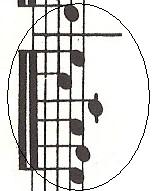
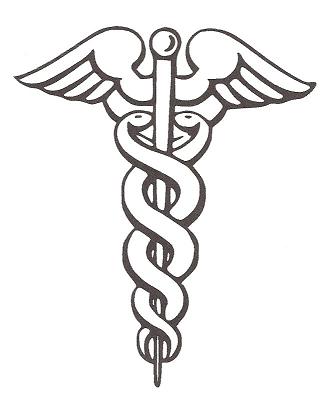
The notes of the theme themselves alternate back and forth between up and down (or yang and yin, like yang and yin signs or chakras). To me, this resembles the movement of a snake, like the two serpents around the axis of the caduceus, the symbol of medicine. Chris Eads describes the theme as "turning around on itself." Turned upright, the notes appear to alternate between left and right too, an even better symbol of yin/yang and the snake winding up the axis. Since the middle notes have the widest gap between them, you can draw a "medicine wheel" around the notes. The 4 directions are apparent, with the middle notes showing the east-west axis and the first and last notes defining the north-south axis. You can also see that the wide notes in the middle correspond to the middle signs of the zodiac in the circular diagram above from the alchemy book. All in all, there is no other piece of music that so graphically represents the chakras and their meanings in its very theme.
|
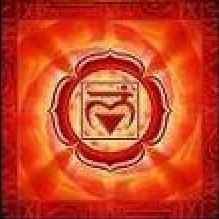
Chakra One
(root) Base of Spine Grounding, Survival 4 petals Saturn/Mars |
|
|
Titus Burckhardt writes in Alchemy, "a serpent or dragon as the image of cosmic power is to be found in all parts of the world...A reptile moves without legs and by means of an uninterrupted rhythm in its body, so that it is the incorporation, so to say, of a subtle oscillation." (p.130). This smooth "uninterrupted rhythm" is characteristic of much of Baroque music in general, and of this piece in particular, with its unique up and down oscillation between each note that sounds like the wiggling movement of a snake. Indeed the rhythm is so seductive it almost sounds like a snake dance. I call Bach's Toccata in F the serpentine toccata. Master organist, composer and teacher Lionel Rogg wrote that Bach’s later organ toccatas are brilliant pieces characterized by an "uninterrupted movement" and "an implacable rhythm," and that they were the basis for the modern form of the toccata. Click HERE to read liner notes by Lionel Rogg and Harry Halbreich for the Toccata in F by Bach
|
But in Bach’s Toccata in F, you have two snakes, not just one-- like in the caduceus symbol! For the theme starts over again just two measures later, now played with the left hand, even as the right hand continues on, each hand now imitating or "chasing" the other in counterpoint (this is called a canon). The two snakes are twirling around each other. One is played with the right hand; representing the yang current, and one with the left hand; indicating the yin current. It is a round, like "Row Row Row Your Boat" (with only two voices). It is the male and female intertwining together to begin the process of kundalini yoga, elevating sexual energy to spirit. It is also a spiralling double helix. In the second canon (Chakra Two section), the hands switch and the right hand imitates the left, thus reversing the direction in which the vortex moves.
And the pole in the center is provided by the held-down pedal note underlying the whole magnificent theme. This OM-like sound of the held pedal note is similar in effect to the tamboura in Indian music. Hear this sound easily in the versions by Winters, Dewar, Alain, Campolieta, Robinson, Leistra and others heard on You Tube.
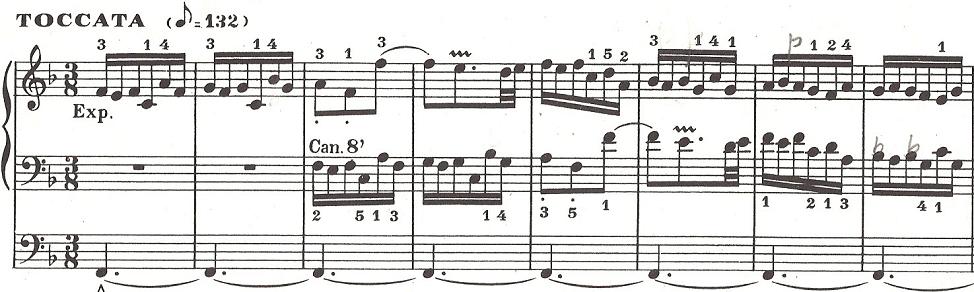
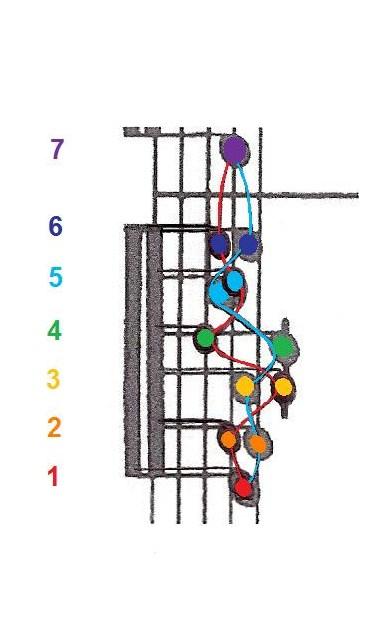
| Superimpose the last 6 notes of the 13-note theme over the first 6, and you have a caduceus (the 7th note represents the crown). The 8th note represents the first level of the downward manifesting current which we meet as we go upward. The manifesting current (Pingala, notes 8-13 of the theme here) is shown in red, the liberating current (Ida, notes 1-7) is shown in blue. |
The notes of the "snake" theme often vary from the strict up/down alternation, indicating shifting polarities between the 3 parts of the soul
(lower, middle and upper chakras); about which more below. Each of the two canon themes (representing Chakras One and Two) has 54 bars (108 total, a sacred number), and each theme has 7 portions,
with 7 to 8 measures each. Throughout this piece, similar patterns appear on many levels, like a fractile or hologram, and they often illustrate the chakras.
For example, in two of these portions, notes in the third measure leap upward optimistically, like the energy released in the third chakra.
Twice as well, the repeating basic theme starts one note higher each time, just like moving up the chakras, and during the second
canon this 7-measure movement starts with C and ends with B, thereby correlating with how the tones are traditionally linked to each chakra:
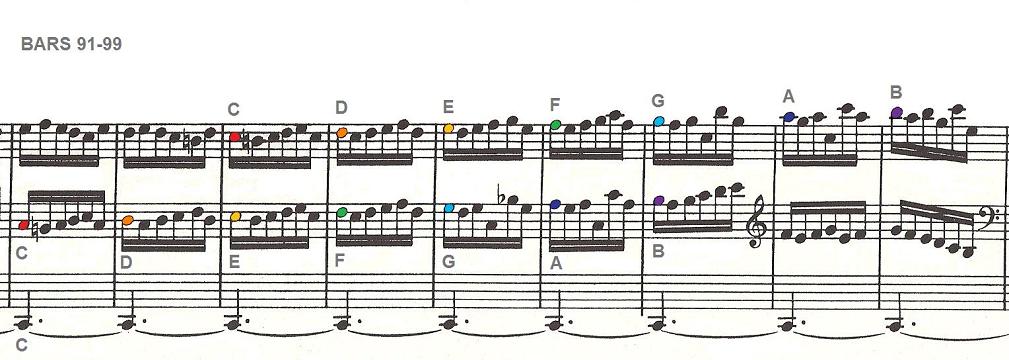
The key changes in the 4th measure of this sequence (moving up from F to B-flat in the first canon, and up from C to F in the second), representing the inner
transformation that takes place at the heart chakra. Later we move back down to the original key, like the downward chakra current.
See the whole score here in pdf
Every section has a liberating part and a manifesting part. After the first canon (with the right hand leading the way, representing the first chakra’s yang polarity), the theme is then played all by itself on the pedals. The foot-pounding solo, and the downward thrust of the music, grounds us and pulls us down toward the roots, or into the dark of the base chakra, just like the manifesting chakra current does, until the very last note leaves us dangling in chaos-- as if out of tune. (In some editions of the Toccata, this note has been changed to a more harmonious dominant note.)
Notice how, during the last 18 bars (and again in the last 22 bars of the second pedal solo), the theme zig-zags downward for 6 notes, then upward for 6 notes, just like the snakes of the caduceus. I think the pedal solos are the most perfect picture of the chakras to be found in music.
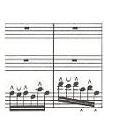
Then at last, three grand chords immediately and boldly announce the next chakra, in which we move upward again.
Chakra TwoThe intertwining snake theme turns counter-clockwise
Indeed, few musical passages are sweeter than this second canon in the Toccata in F. This tender joy indicates the chakra’s
yin or feminine polarity. The music also conveys a wonderful fluidity. Somehow the softer sound of the lower notes played by the left hand, leading the higher notes
played by the right hand, allows a sweeter feeling to emerge. The subconscious, softer, more relaxed and feminine part of us is
leading the way. The gender correlation can also be reversed, however, since male voices are lower than female ones. Is this gender fluidity?
Both canons together have always given me the impression of a world coming to life again, as if Kundalini or Shakti is rising out
of the trap in which she is originally found, coiled like a snake around base of the spine. Now she’s being released, and nothing represents this liberation and new life,
nor the sacred fire of the divine feminine, better than this sweet, snake-like music. The OM sound of the pedal, and the vibrant notes twirling around it,
evoke the powerful movement of life as it unfolds "implacably" within and all around us. Pause, listen, awaken, and participate!
I want to emphasize this point. Many canon (imitation) themes were written in Bach's times, including Michael Maier's,
which had some inverted voices (more about Maier below). But there are few if any other pieces with just two canons in it,
each with the opposite hand leading. Bach was clearly making a symbolic point here. And it's no accident that the second canon sounds sweeter.
The significant thing here is that there is almost no difference at all between the actual notes of each canon. The effect is mostly achieved just by
switching the hands, and yet we notice the difference.
There is one other difference: the right and left hand are two octaves apart, symbolizing chakra two, until the notes ascend through the chakras
in the portion shown above. Then, by changing just two notes, Bach returns to imitating the notes one octave apart.
This happens in bar 99. It is an amazing moment, here in this sweetest part of the Toccata. The right hand (top staff; the "male" side) jumps ahead and leads the left again,
just for this one bar. It is imitated in the left hand 2 measures later in bar 101. Then, two measures after that, the right hand imitates it again (bar 103).
Three times in all. Mmmmmmmmmm; seems symbolic! They are the 3 apples of Atalanta! (see below) Male and female are intertwining.
In making these minor changes to the second canon (and to the second pedal solo too), Bach was working within the limits of the organ keyboard; but considered
from a mystical, symbolic view, everything is part of the divine order--- including the artistic medium in which it's expressed.
Once again, after the hands play the canon/snake theme, the feet play it solo in the pedal. This is the manifesting current of the 2nd chakra.
I don't know another piece with two pedal solos in the midst of it either. This also seems highly symbolic. The foot movements ground us again,
showing we are still in a lower chakra. The snake is a symbol of "temptation" too, representing the sensuality and worldliness of the lower chakras.
But the 2nd time the theme not only moves downward through the pedals, but makes upward leaps too, and moves around with greater freedom.
Then, it readies us for the next stage: the "takeoff," which comes suddenly as we enter the next chakra.
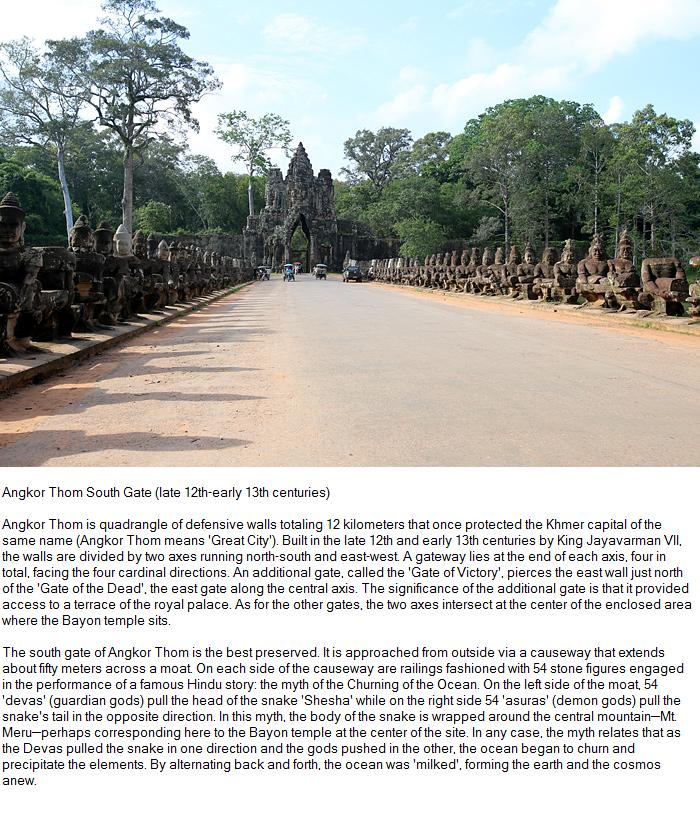
Footnote: The Hindu myth of the serpent churning the ocean of milk to produce the elixir of life,
illustrated by a great frieze at Angkor Wat temple and by magnificent sculptures at the nearby great city of Angkor Thom, corresponds to the toccata's snake themes. The myth says that 54 deva gods and 54 demon gods each pulled a snake back and forth in the opposite direction spiralling around the central mountain, thus precipitating the elements. This also refers to sanskrit, which has 54 yang letters and 54 yin letters. How did they know about the spiral milky way galaxy? And how did Bach know to write 54 bars for each of the two spiral snake themes that "churn" in opposite directions?
Father Charlie Moore introduced me to the "solar cross." He showed how the seasons are a great spiral of the Sun rising in the east and setting in the west each day, moving north a little each day along the Earth axis toward the summer solstice, where it changes direction and moves south. This is celebrated worldwide in the spiral solstice dance, which Bach put into music in the two Toccata in F spiral snake themes moving in contrary directions.
Remember that Jesus gave the first Pope Peter the keys to the Kingdom of Heaven, one that binds (manifests, coagula) and one that loosens (liberates, solve), in both Heaven and Earth (i.e. up and down the chakras) (Matthew 16:19). This principle works in the common spiral screw, which binds when turned clockwise and loosens when turned counter-clockwise.
|
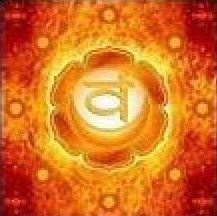
Chakra Two
(sweetness; my place) Lower stomach, above Genitals (sacrum) Desire, Joy 6 petals Jupiter/Venus |
The Chariot theme; a portal of power
Suddenly the music bursts into flames, as we move into the 3rd chakra. "Piercing chords" arouse us to rise up and move.
Judith indeed compares chakra 3 to the fire element.
What’s more, she says, it represents our courage, power and will. Indeed, any virtuoso organist who has played Bach’s Toccata in F can testify
that it takes courage to play the next three sections! Now both hands and feet are playing elaborate themes all at once. Entering this
third section, representing the solar-plexus or power center, it seems like a change of state has occured, from the more joyful but dense tamas
phase, to the passionate and ambitious rajas phase. We enter it through a portal of power, which is also the end of the second chakra section.
Here the wiggling snake is transformed for the first time into two great columns of chords.
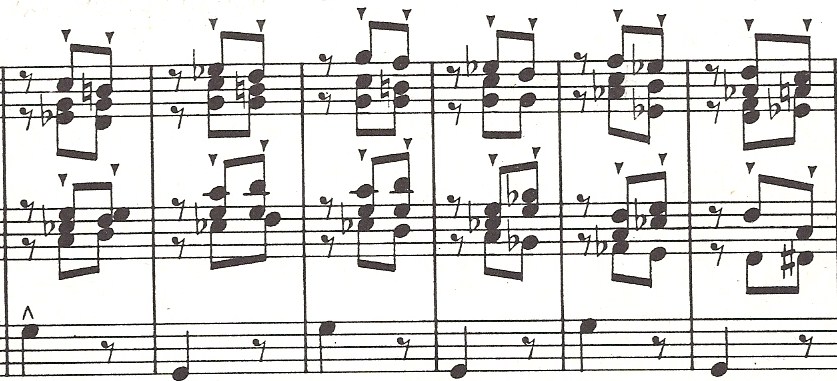
First a pedal note sounds; then two chords, and this happens 6 times. I call this the "chariot theme." It puts the listener in motion. It is also a model of the
chakra system, and of the entire toccata in miniature. Here again, there's 12 chords in all, one for each zodiac sign, and just like the signs they come
in pairs of higher and lower notes (yang and yin), sounding like the two left and right columns on the Kabballah's Tree of Life.
The pedal note preceeding each set of two chords alternates between higher and lower octaves, representing the yang or yin polarity of each chakra.
The theme is then capped by another pedal note, followed by the same three chords that announced the second chakra. These 3 chords preceeded by a note are
heard often from now on, and they have special significance. Here they represent the crown chakra.
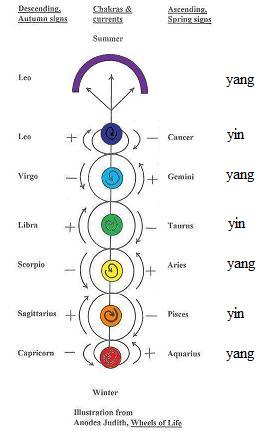
| See the chakra system outlined at left. The toccata's chariot theme (see below) is a model of this system. Two chords for each level, in pairs of higher and lower notes, represent the two currents (- yin and + yang) and two signs (- yin and + yang) on each chakra level. Plus, remember each chakra is itself either yang or yin (indicated by a primary or secondary color). The toccata indicates this by the pedal note alternating between high and low before each of the 6 sets of 2 chords. Then the theme is capped off by a pedal note followed by the 3 chords, for the violet-colored crown chakra. Note the crown and the 3 arrows in the picture. |
The graceful up-and-down octave movement on the pedals brings into view the vertical staff of the caduceus. And the 12 chord columns still "wiggle" between higher and lower notes, just like the original theme. In the 12 chords, the 12-note original theme is given a larger and slower treatment, fractal-like.
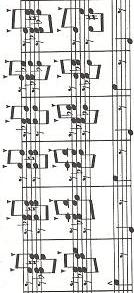
|
|
The chariot theme is like moving triangles, each composed of two chords preceeded by a pedal note. The pedal notes, one higher and the next one lower, are the apex of the triangles; one triangle pointing up and one triangle pointing down. Or notice the two successive wedges formed just in the pedal notes (the bottom staff): the first 3 notes form a wedge that points down, and next 3 form one that points up. You can see this in the original theme too, where the first three notes are a triangle pointing down, and the second three are a triangle pointing up. This pattern represents the Merkabah, the soul’s chariot on its journey to "the other world."
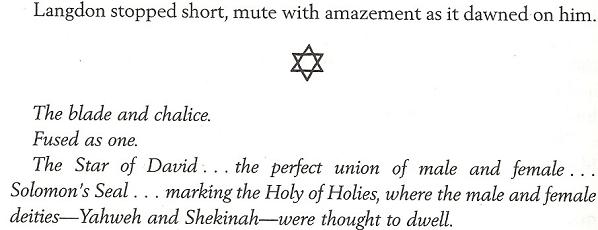
Those familiar with The Da Vinci Code by Dan Brown may also recognize this chariot figure as the two icons for chalice and blade, or male and female, one pointing up and one down, which when combined form the Star of David from the Temple of Solomon-- also a symbol of the Merkabah, our vehicle of ascension. The pedal notes shifting up and down thrust the Chariot up the chakra tree, both here at the portal to the 3rd chakra, and throughout the mystical journey, since we hear this theme again (once for each chakra) in all the following sections. The chakras are the wheels of our chariot of ascension.
The pedal note and 3 chords that before had introduced the 2nd chakra, now announce that we have entered the Third.
Begins with a fiery and uplifting arpeggio, the first hearing of the liberating or uplifting theme
Manipura
The whole theme is repeated 4 times, modulating (changing) through 4 different keys. Beginning immediately and confidently, this new rhythmically-bouyant and
uplifting theme represents our will, which we contact in our 3rd chakra. Nothing could evoke it more clearly than this powerful and grand musical figure.
Chris Eads calls it a "rocket." It also depicts the chakra spiral, repeating over and over and starting again where it leaves off, just like a turning wheel.
This third chakra connects to our will and power. Anodea Judith explains that personal power is not created by domination, but by coordination among parts of our being, and by working together with others. Here this new energy and coordination is represented by hands and feet playing this new courageous, uplifting, liberating theme together in counterpoint. The feet always play the theme first, in the lowest notes, which shows that the subconscious and sensual passion (developed or tapped in the 2nd chakra and in the
pedal solos), fuel our will, especially when well programmed by our higher centers. In fact, a couple of measures of the 2nd pedal solo anticipate the new uplifting theme,
with only a one note difference. Bach is showing the groundwork that must be laid for our ascent.
Remember in the original snake theme how the 7 notes are wider apart in the middle and closer together at the ends? Placed upright, the middle notes resembled the
horizons of the medicine wheel and zodiac, and the beginning and ending notes appear vertical. Now we see how this is reflected in the whole Toccata, since
one theme dominates at the beginning and another at the end, in vertical fashion; while in the middle the two themes are equal, as if horizontal. We see the fractal effect again.
This is also the shape of the
Tree of Life symbol.
The second manifesting half of the 3rd chakra is introduced with huge, grand chords. The most powerful notes of the
Toccata are heard at the center of our center of power. Then a new version of the original 13-note "snake" theme is played with both hands and feet, As in the first chakra, the right hand plays the original theme, and then the left hand imitates it, so it is yang or male like the first chakra that turns in the same direction, reversing the previous yin chakra. It's now in a
minor key (d minor; related to F major, the key in which the first chakra-- also having a yang polarity like the 3rd-- began). The returning "snake" theme reminds us of the 2 chakras "below." We are meeting the downward current on the other side of the chakra, represented by the original manifesting snake theme-- this time of shorter duration-- and in grand style. The minor key also represents the downward trend.
The snake theme takes us upward at first, but then the leading hand plays 7 notes rapidly down the scale, as if the manifesting current were moving
down the 7 chakras. Then the pedals perform a torturous descent, just like the 1st pedal solo, with the left hand imitating it in harmony. It is also
accompanied by a slower, descending up and down movement in the right hand. Finally, 7 more rapidly descending notes (one for each chakra) lead us into the
next chakra section. This happens in the 4th and 5th chakras too.
Opens with the uplifting arpeggio again, but it is calmer
Furthermore, in the middle of the third chakra, an unresolved chord had led us into an
extra upward-moving passage that gives the distinct impression that we are making a tortuous and difficult ascent; and this happens again in the fifth chakra, and the 7th (all yang chakras). Here this passage is omitted, and the first half of the heart chakra section ends (after the "chariot") on a quiet tonic chord. This gives the fourth chakra section a more peaceful feeling than the third, representing the calm yin polarity of the heart chakra. The missing "difficult ascent" passage, built from the liberating and then the manifesting theme, here doesn’t block the heart’s center; representing its "balance" and serenity. That means the two currents, upward & downward, Ida &
Pingala, are now in equilibrium, and so we feel centered here in the very middle of the Toccata, as if we’re in the eye of the storm. The Toccata reminds us that we always have this "unstruck, unhurt, innocent" part of us that we can return to, even in the midst of our troubles.
This picture of 8 Earth orbits related to 13 Venus orbits is a logo of the Toccata in F, S. 540. 5 petals, in 4 sizes, within the 0 of Venus' orbit.
The Hindus symbolize the heart chakra with a 6-pointed star instead of a 5-pointed star. It represents the two chakra currents that are balanced here, one going up and one going down. That is the same symbol as the chariot theme. But these 6 points of the Hindu star are inscribed within the chakra's "12 petals." The 5
Platonic solids are proven to be the only possible regular geometric polygons. One of these, the Dodecahedron, contains both symbols, since its 12 faces each have 5 sides. Each Platonic solid was linked by Plato to a classical element; for the dodecahedron it is ether or spirit, the 5th element (also called the universe, the zodiac or the heavens). Each angle of the 5-sided face, or regular pentagon, has 108 degrees, which = the number of bars in the two canons of Toccata in F. The 5 angles add up to 540 degrees, the BWV number of the Toccata.
The lines within a pentacle are related to each other according to the fibonacci proportion of 1.618. Of course, this "divine" or
golden proportion shows up strongly in the Toccata in F. Here in the middle of the heart chakra, just as the "liberating" portion (liberating and chariot themes) ends and the "manifesting" portion (snake theme) begins with a majestic triple chord, we reach 271 bars out of 438 (438 divided by 271 equals 1.616). The length of the liberating and manifesting sections in each of the first 5 chakra sections are related according to the divine proportion; but they are close to exact only in the heart chakra, and in the 2nd chakra (where Venus is exalted). (HERE is a footnote describing all the mathematical and geometric proportions I have so far discovered in the Toccata).
If you're watching the Toccata on You Tube, notice that the status bar reaches the divine proportion in the middle of the heart chakra section. This happens in both the video of the 4th chakra section only (embedded above), AND in videos of the whole toccata-- the fractile effect again!
Anahata
Then as the snake theme returns in the manifesting half of the fourth chakra, the left hand leads the way again, signifying that this is a yin chakra (as it will in the 6th chakra); whereas the yang right hand had come in before the left in the third section, and will again in the yang 5th.
After a similar upward climb as before, the same rapid "downward" movement in the pedals is heard as in the previous section; this time imitated by the higher notes in the right hand, with the left hand in the middle accompanying with slower notes. As we move higher, so do the notes. This combination, with the slow notes in the middle, seems to elicit an infinity of sound. We are now in A minor, related to the C major key of the previous yin section (chakra 2). "Related" major and minor keys have all the same notes on the keyboard; except that the minor key starts the scale two notes below the major key. Remember we saw this also with the first two yang chakras #1 & 3, d minor being the related key to F major.
Opens with the third uplifting arpeggio; more insistent now
This time, in the manifesting second half of the 5th chakra section, the "downward" movement that once was laboriously played out with the feet on the pedals and imitated with one hand, has now been transferred upward to both hands alone. The pedal plays the slower accompanying notes. This not only represents the manual dexterity of Mercury, but indicates that we are opening up our higher mind. At the same time, we feel uncertain and restless (like Mercury) as we get higher. Some listeners begin to wonder, and to ask our Master Hermes/Bach, "will we ever get to the top?" Will our great work ever end? Is this the darkness before the light?
This time, the key is g minor, the next relative minor down from d minor (3rd chakra). And this time, the g key of the 5th section is the same as the G tone of the 5th chakra. And the 5th chakra's planetary master, Mercury, shows this link to G in its cosmic, mathematical behavior, just as Venus did with the Heart, since it rotates three times every two revolutions, which is the proportion that produces the beautiful fifth tone or "dominant"= G in the C-major scale.
Vishuddha
The uplifting arpeggio sounds a fourth time; but now it introduces a breakthrough
Ajna
The uplifting arpeggio is stretched out into a new theme of bliss and glory
The kundalini energy then is fully unleashed, as the uplifting, liberating theme rushes up and down the keyboard and is turned upside down and back again with
reckless abandon. Our spines tingle as light and sound flushes through us, connecting us to the cosmos. As the notes ascend they point downward
(like the manifesting theme), and as they descend they point upward (like the liberating theme). The 2 currents: Liberating/Manifesting, Earth goddess/Sky god,
Shakti/Shiva, combined and united in the sacred marriage
in Bach's glorious music.
Then, the 12 chord-columns of the chariot theme sound again. This time the notes, and the chariot, are descending from the heights.
Finally, in an amazing stroke, Bach brings back the passage of tortuous ascent that he had cut from the heart chakra, and attaches
it here to the end as the final coda. Now however, it seems like a theme of conquest and resolution, connecting the cosmic energy of
the crown back down to our heart; and back into the earlier struggles too. We are invited to return downward through the chakras again on the current of manifestation;
to bring our new realization back to the world to help others.
We are back in the original key of F major too, as if ready to begin the entire adventure again-- perhaps on another
level. Indeed, the final chord is just like the chord that boldly introduces the second chakra, as if it is introducing the first section again,
thus allowing us to start the whole Toccata over again.
Sahasrara
But if the listener chooses, (s)he can move on instead into the Fugue in F that follows theToccata,
in which the new serenity and peace you have gained moves smoothly through two entirely new main themes, as if floating in glowing clouds of glory;
each theme entering successively, one radiant and the other more quiet and serene, and then combined together at the end like an alchemical marriage of
Sun and Moon in the 7th chakra. During the first theme, the glorious crown theme of the Toccata is alluded to often, and the second theme in places resembles
the Toccata's second theme, the "liberation" theme of upward arpeggios. The Fugue could also represent the 8th chakra above the head; the higher octave,
and the first step into the spiritual world.
It is a fun exercize to visualize the colors of each chakra,
and pay attention to each center’s location in your body, while listening
to each section of the Toccata in F. For which color corresponds to which
chakra, see the chart below. For those more dedicated,
listen more intently with a quiet mind, and practice this often, and the Toccata can release the kundalini energy and unblock your chakras.
It's powerful stuff, so prepare yourself!
The whole musical image of the Toccata in F so clearly represents
kundalini that we have to ask, how could the devout Christian J.S. Bach
have been aware of the Hindu system of Tantra yoga, or even of astrology,
or alchemy-- sometimes called the kundalini of the West? Well,
we know that alchemical symbols like the caduceus are embedded in Western
tradition and found all over cathedrals, on Christian crosses, and on other
forms of Christian art. Bach was certainly well-exposed to the Western tradition
in all its richness, and we know (as Albert Schweitzer has pointed out)
that he used musical symbolism in composing his organ works (his Prelude
and Fugue in E Flat is clearly a symbol of the Trinity, for example; and the wedge ("wedge fugue") is a masonic and kabbalistic mystic symbol). But
maybe this kind of esoteric knowledge wasn’t necessary to Bach. He simply
opened himself to whatever came to him from divine inspiration, and a universal pattern unfolded. The Toccata certainly is a mystic meditation on the soul's
heroic journey to enlightenment through 7 levels, which
Robert Place says is a venerable ancient tradition.
And I have realized an interesting little fact. Have you noticed? The word "toccata" has 7 letters! (and so does the word "chakras"). And "toccata" is entirely made up of
4 "elements", the letters t,o,c,a. Substitute r for c, and you have the same 4 letters appearing in the word tarot! They are also used in the anagrams for the
esoteric traditions: rota, tora, taro, etc. This acronym is often shown on the
Wheel of Fortune
tarot card, and "tora" is sometimes written on the scroll which the High Priestess holds.
This links "toccata" with "tarot" in a quite literal way. I explore the link of tarot to Bach's Toccata in F
below.
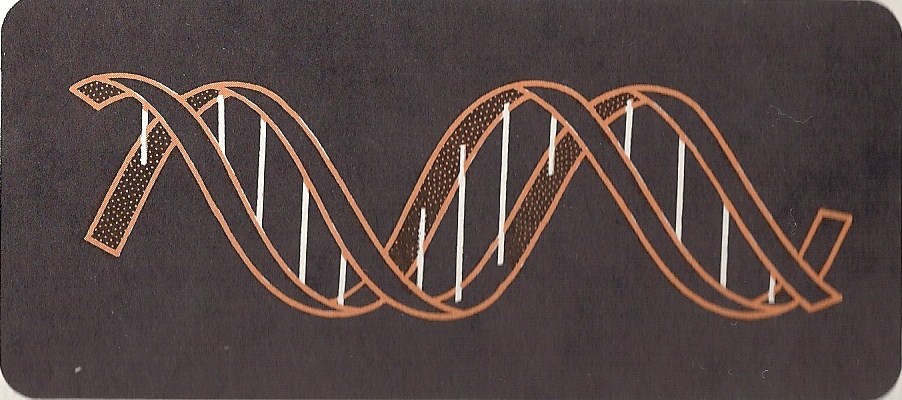
It might even be that Bach anticipated discovery of the double helix of DNA. The Toccata's initial motif, stated in the first measure and repeated thereafter in varied
forms, although it contains 6 notes, is built from 4 different notes (FEFCAF), like the 4 elements, and the 4 molecules of DNA.
The single strands of the following pedal solos are even like RNA. The double helix of DNA lies coiled in the first and second chakra areas,
in the sperm and ovum which when released transmit our genetic code, just as the helix-double snake of kundalini rises from our base to unleash
our own spiritual rebirth. We hear its transforming power in the two helix-like canons of Bach's Toccata in F. Life is created through two intertwining
strands bringing genes from two lives together. The two strands or snake themes twirl around each other, swinging and dancing together in
sexual union as they generate new life. Bach's themes are perfect symbols for DNA, and of the first two genital chakras and their corresponding organs
that reproduce and transmit it. Once again, the 4 letters of the DNA code (T,G,C,A) resemble the 4 letters (TOCA) that make up the word "toccata;"
in this case G is substituted for the "O." Just "flip the switch" and they are the same letter. Consider further where this switch is, and where it goes. You take the O on its right side, the side of experience, and move it inside the circle (the O) into its heart, to make a G to complete all four letters of DNA. This means that when we experience the beauty and power of a Toccata for ourselves on the inside (the inner experience of any toccata, but especially of this most-archetypal one in F by Bach, with its 2 DNA-like canons), we connect to our spiritual evolution and to the DNA of our civilization and to all of our lives forever.
(DNA illustration from Goin & Goin, Man and the Natural World, p.263, MacMillan, 1970)
("toccatatoccatatoccatatoccatatoccatatoccatatoccatatoccatatoccata......")
The toccata's links to string theory is another intriguing idea opening up.
click here for a footnote on another famous idea illustrated by the Toccata in F:
Spiral Dynamics of Integral Philosophy.
According to Robert M. Place, creator of The Alchemical Tarot, "it was believed that the
philosopher's stone would transform any substance into its highest form." (The Tarot, p.47) Since the alchemist's quest is like the process of
kundalini in which we move up the chakras to enlightenment, the planet exalted (raised to highest expression) in a chakra has an important connection to that chakra.
Most obviously, the first chakra is red because the red planet Mars is exalted in Capricorn, a first-chakra sign; and the 3rd chakra is yellow because the yellow
Sun is exalted in Aries, a 3rd-chakra sign. Notice that Mars is exalted in an earth sign (Capricorn), thus indicating the earth element of chakra 1;
Venus is exalted in a water sign (Pisces), thus the water element of chakra 2; and Sun in a fire sign (Aries), thus the fire element of chakra 3.
Saturn is exalted in an air sign (Libra); thus the air element of chakra 4-- except that the Moon is also exalted in chakra 4 (Taurus, earth sign),
the heart being the only chakra in which two planets are exalted; which complicates the issue!
The table shows how I have resolved it. For example, notice how two planets of such opposite natures (Moon and Saturn) being exalted in the heart,
accents its role as the central point of balance. The Moon is exalted in the yin sign Taurus, Saturn is exalted in the yang sign Libra; so the heart balances yin and yang.
Ellen McCaffery in Graphic Astrology p.132 is my source for Neptune exalted in Leo, also
Indigo Ray; some others say Cancer.
Also included in this table are some New Thought categories, and how I correspond them to the chakras and the signs. Note that Fillmore's
12 Powers correspond not only to the chakras and the zodiac, but to Jesus' 12 disciples. This latter meaning of 12 may be how the 12-fold pattern entered Bach's mind as he wrote his Toccata in F. The original theme's
13th note represents Jesus, and the 3 notes of the 3rd bar may represent the trinity.
Lest you think that correlating air with the 5th chakra, instead of the 4th, is somehow "out of order," remember that (symbolically, in terms of physics),
the correlation of elements to chakras is already out of order. True, just as earth melts into water, the 2nd chakra located above the 1st represents a
higher and faster vibration. But water does not, in turn, evaporate into fire, but into air (gas). So corrrelating the 3rd chakra with fire, instead of air,
is already out of order! Bumping air up to the 5th chakra is therefore not inconsistent. As Robert Place has pointed out, the chakras were known in Western
esoteric philosophy since Pythagoras, so we don't have to defer to Indian tradition as if it were the only one. Pythagoras called the chakras the 7 "soul centers"
corresponding to the 7 visible planets and 7 musical tones (the music of the spheres). These correlations are still very much a part of new age chakra tradition today.
Somehow the creators of tarot understood that the middle chakras resonate to this "reverse order" of the elements-- as indicated when they put the card for
Plato's highest virtue (Justice) in the lowest position in the trump order, and Plato's lowest virtue Temperance highest, with
Strength in the middle. Robert Place says "the creators of this order were suggesting that the virtues are coming to us as a divine gift, and that they are
proceeding in the opposite direction as time and fate" (The Tarot, p.106). Then the Golden Dawn reversed the positions of the Justice and Strength cards.
In the table above you see that Strength now corresponds to chakra 3 (navel/fire), Justice to chakra 4 (heart/ether), and Temperance to chakra 5 (throat/air).
At the right in the table I have correlated the four cardinal virtues and the
three Christian theological virtues, in the sequence in which they appear in the
tarot journey, with the 7 chakras. That means you can activate each virtue by focusing on the corresponding chakra within you.
More about tarot below.
Justice is perfect balance; in the 4th chakra it signifies the balance between not only air (present for the first time in the ascent), but ALL the elements,
brought together in harmony within the authentic core and spiritual center of our being. The physical heart, in fact, has 4 chambers on 2 sides,
for the 4 elements (2 yin and 2 yang). So the heart's element is Spirit. The 5th chakra is the gateway (and guardian) between the higher and middle soul.
It's planetary spirit Mercury, exalted in Virgo (sign of purification), is the purifier, of metals, morals and minds. The word Temperance originally means
"finding the right mixture," which is similar to the sanskrit name of the 5th chakra, which means "purification." As further "proof" that the 5th chakra is air,
note that the thyroid gland in the throat has the richest and purest blood in the whole body, and blood carries air (and is linked to air in Greek medicine's humor theory).
There are other common associations of colors with chakras: white or gold with the crown, pink with the heart (also yellow, white, purple with the sacred center), etc.
Pink and green may indicate self-love/love of others, but which is which is ambiguous. Remember that correlations of elements, colors, planets, etc. to chakras
(or to sephiroth on the Tree of Life), are not physical formulas designating one thing exactly equal to another;
they are more like rhythms, which bring the parts of our being together like instruments playing in a symphony, the "music of the spheres."
Like a hologram, each chakra is specialized, yet contains the whole.
When we understand and behold these grand correlation patterns, we learn grace and balance. They are the essence of the hermetic philosophy,
whose core principle says "as above, so below; as within, so without." The cosmic order is reflected on many levels, including within ourselves.
What about that other Toccata? (in D-Minor, S. 565)
What does it represent?
Hint: I think the "name of God" in Hebrew-- YHVH-- forms the basis for its famous 4-part fugue theme; and it’s also like a cross with the 4 directions.
Briefly, the first four notes come down from above (like Y), the second four notes move upward from the middle
register (like H), the third come up from below (like V), and the final four notes repeat the second four (like the second H. The 2 Hs could also stand for "Horizontal",
and the V for "Vertical").
Robert M. Place has clearly demonstrated in The Tarot: History, Symbolism, and Divination,
that the sequence of 22 trump cards (now also called the Major Arcana) is a triumph parade. In a triumph parade, an elaborate live event from ancient
and renaissance times (which was always accompanied by music I might add), each character in the procession triumphs over or "trumps" the one before,
thus telling a story or "moral" allegory revealing a journey from lowest to highest. The Renaissance artists imitated this parade when they created the tarot cards.
In the tarot's triumph parade, each card "trumps" the one before it, thus describing a journey of the soul, represented by The Fool, to enlightenment or
"back to God." It represents a stairway or ladder from lower to higher consciousness. The "trump card" series of the tarot, numbered from lowest to highest, starts with the Magician (trump 1) and ends with the World card (trump 21). Each tarot card in the trump suit of Major Arcana represents a stage in the spiritual journey that trumps the one before.
Here is a good introduction to the Tarot story (The Fool's Journey) as shown on
You Tube, with music by Stewart Copeland.
So why did the occultists of the Hermetic Order of the Golden Dawn and the Builders of the Adytum (BOTA) align these cards with the Kabbalistic Tree of Life in a
descending sequence instead?
The Tree of Life (see diagram at right) is the symbol in the Kabbalah
(or Qabala, Cabalah), the Jewish mystical tradition, for divine creation and its reflection within us. See the Tree of Life as depicted by BOTA
HERE.
It represents the process of creation according to the Platonic theory of emanation. The goodness of God emanates down the Tree, from Kether,
meaning crown or knowledge of God (usually linked to the crown chakra), through 10 phases (represented as circles or "fruits" on the Tree), to the lowest in Malkuth,
the "worldly kingdom" (usually linked to the base chakra). The Tree symbol's 10 circles are arranged on 7 levels, with 22 pathways connecting the circles.
But the story told by the tarot trumps is the journey of the soul back up to God (or enlightenment, the mystic realization) from worldliness,
so it must be a journey UP the Tree of Life from Malkuth to Kether. They do not represent God’s descent into form. They represent evolution, not involution.
Although the currents of the chakras in the caduceus run both ways, Place’s research shows that the trumps are a ladder or "stairway to heaven" that starts
with worldliness and moves toward spirit. So the tarot trumps describe the upward, liberating journey. Therefore the famous poster of the
Tree of Life created by the Builders of the Adytum needs to be changed to run the tarot journey UP the Tree.
The first ten "path" numbers, of course, represent the Ten circles or sephiroth, the fruits on the tree of life. This is the sequence of emanation downward followed
by God in creating the World, so these numbers don't need to be changed. The 22 pathways are lines connecting these circles. They start with "path number" 11 (not #1),
which represents the Fool, and path number 12 represents the Magician. In the Golden Dawn's correlation, paths 11 & 12 are connected to Kether (Crown, the highest circle or
"sephiroth #1" on the Tree). The other paths are numbered down the Tree from there; making 32 "paths" in all (10 Sephiroth plus 22 pathways).
Here is a diagram of the 32 paths, and
Here is one showing the tarot cards on the paths.
But once one has reached the Worldly Kingdom, (Malkuth), at sephirah #10 at the bottom of the Tree, why not continue the numbers again from where you are,
and number a path connecting these circles at the bottom of the tree as number 11, and move upward from there? The Fool would remain path #11, and
The Magician path #12, but both would be placed on one of the paths connected to Malkuth at the bottom of the Tree. Then the Tree of Life would be
aligned with the other great myths and symbols of our mystical tradition.
Place says that the most-usual way of numbering the paths was not the only one within Kabalistic tradition; just "the one which influenced the occult tarot."
So there is nothing sacrocanct about this order, even within the Kabalah. My diagram at the right shows this way of numbering the paths #11 to 32
FROM THE BOTTOM UP the Tree of Life, instead of from the top down.
That the path numbers on the Tree of Life should be reversed is clear from the nature of the story told by the Tarot.
The allegory told in the tarot trumps moves through 3 sections, representing
the 3 parts of the soul. This is reflected in the 3 parts of the brain. Most interpreters, such as
Paul Foster Case of Builders of the Adytum, acknowledge this three-fold division of the Tarot's trump cards,
in which each division contains 7 cards each, with the Fool as an extra card usually numbered zero. What they often miss is the importance of the direction
of the Tarot’s story-- the Fool's Journey UP to enlightenment.
The first section of the trumps (I to VII) is definitely worldly, revealing that we are starting from Malkuth, the kingdom of the world, and the first chakra,
and moving
upward. The Magician guides us on our path. Through divination, he helps us bring God's beauty into the world; unless he appears in his lower guise as the
trickster or gambler beguiling us out of our money. Two sets of worldly imperial rulers, one secular (The Emperor and The Empress) and one sacred,
but just as worldly (The Female Pope or High Priestess, and the Pope or Hierophant/High Priest), show the temptations of power and ambition.
They are the sometimes-troublesome moral and spiritual authorities which can guide us or block us on our journey.
Remember also that in the Renaissance, when tarot was created, the Pope was both a king who ruled territory, and a kind of powerful emperor whom many kings bowed to.
The Lovers is the card of 2nd-chakra sensuality, lust and romance, but also the love and desire by which we choose our path in life. Fueled by this Love,
we then mount The Chariot, ready to ascend further up the tree.
If this first section of the trumps is worldly, and we are not deceived by the apparent stature of the four powerful rulers
of Malkuth’s Kingdom into placing them at the top of the tree, then it clearly aligns:
The second section of trumps (VIII to XIV) clearly represents the soul's valiant struggle with the limits of time and fate, and the
3 cardinal virtues developed or given by grace to help the soul in this struggle. It is an arduous ascent up the tree of life, which
the soul has chosen in order to triumph over death in enlightenment and liberation. If the soul stays on the pleasant and comfortable worldly level,
it cannot develop the strength and wisdom to rise up the tree to spiritual immortality, but instead will be forever subject to the world’s kingdom
and ruled by its appetites and compulsions. In the third chakra the virtue of Strength at the solar plexus gives us the power and will to overcome
the obstacles to our ascent, and we enter the ascetic path of The Hermit to learn the discipline and patience of spiritual practice. We learn from the
Wheel of Fortune, representing Fate, that the world's rewards are fickle and uncertain, and we develop the virtue of Justice to follow our own
inner gyroscope instead of just reacting to circumstance. We undergo the sacrifice of initiation with the Hanged Man to remain true to our heart’s
guidance despite opposition, and we learn to release ourselves from social "hang-ups" so that our heart energy can flow. At the throat chakra we even stare face
to face into the abyss of Death so we can change and grow more easily. We develop the virtue of Temperance to adapt to all these challenges
with greater equanimity and poise.
Clearly then, we are aligned:
The last seven tarot cards in the third section of trumps (XV to XXI) complete our ascent back to the Spirit. First we meet the Devil,
who administers the final temptation. The last layers hiding our demons and illusions are stripped away. We discover we can escape the Devil's chains.
Then the lightning flash strikes down the Devil's worldly Tower of Power, so that the lower two parts of the soul no longer rule us. The obstacles
now cleared away, the glories of spiritual realms are suddenly revealed to us in The Star, and the two halves of our being are integrated. Inner vision
is opened at the 6th chakra. We climb the stairway to heaven through planets of ever greater radiance, from the Star and the 7 planets to The Moon
and The Sun, and we transcend the time they keep and consummate the alchemical divine marriage of male and female within. In Judgement
we are released from our graves of living death, and attain spiritual immortality, the mystical goal; and we achieve enlightenment and union with the universe at
The World (crown chakra). We dance upon the throne of God. Without a doubt, the Tarot has taken us up to the top of the tree, not down to the bottom!
We have rejoined God (the mystic truth), and have aligned:
Given this clear direction of the Tarot up the tree of life, what about the 22-letter Hebrew alphabet to which occultists link the 22
paths on the tree of life, and the 22 Tarot trumps? Each Hebrew letter represents a concrete image, starting with "ox" for the first letter aleph, and "house" for beth,
and so on through "cross" or "mark" for the last letter tau. Occultists generally link the first letter aleph or "ox" with The Fool (trump zero), the second letter beth or "house" to
The Magician (trump one), the third letter gimel or "camel" with The Priestess (trump two), the fourth letter daleth or "door" with The Empress (trump three), and so on.
The complete list of correspondences can be found on page 81 of Place's book The Tarot, and also at the
BOTA web site,
as well as included in my table below.
Arthur Waite and Robert Place point out that the images on the cards resonate more strongly with our psyche than mere letters.
But some of the simple images represented by the letters correspond to those on the cards. Religion (as in The Pope)
means to bind, and so does a nail (the letter corresponding to The Pope, or 5th trump). Occultists and thus "Magicians" named their Masonic orders after housebuilders.
The eye (the Hebrew letter linked to The Devil card) can be a prime source of satanic temptation. The cross represents the four corners of the world depicted on the
World card. And so on.
The Hebrew alphabet and its images can also be seen as describing the spiritual journey, as it does in the Bible. If the Hebrew
alphabet contains 22 letters, and the Tarot 22 trumps, a logical correspondence can be made between these two spiritual systems; even though the Tarot was not
historically based on the Hebrew alphabet. The simple images associated with the letters can work the same way as tarot images. And it is quite a coincidence that
Tarot cards have 10 numbered cards in each suit (same number as the Sephiroth of the kabalah's Tree of Life), as well as 22 trumps (same as the number of pathways);
and that the 10 planets plus the 12 signs of the zodiac, which are traditionally linked to the letters and pathways, = 22. The zodiac is itself another hero's journey story, like the letters are, and if we add the planets the zodiac also has 22 parts. It makes sense to correlate the various versions of the story.
Here is where I see something that has not been pointed out elsewhere to my knowledge. If we align the Hebrew alphabet with the journey UP the
Tree of Life diagram, instead of Down, as is usually done, we can see that, just like the Tarot cards, the Hebrew alphabet falls into three distinct groups of seven letters each.
Furthermore, the obvious meanings of these three groups of letters coincide perfectly with the meanings of the
three groups (low, middle and high) in the Tarot, the Tree of Life, Platonic and Hindu philosophy, the chakras, the toccata, and all the other systems, where there is a
lower worldly or sensual part, a middle moral or passionate part, and a higher rational or spiritual part. And yet on the BOTA Tree of Life, the higher letters are placed
on pathways at the bottom of the tree, and the lower letters are placed on pathways at the top of the tree. From the evidence of the meanings of the letters themselves,
this order needs to be switched!
Another interesting coincidence appears when we compare the first 8 letters to the Christian Joyful, Sorrowful and Glorious Mysteries
we discussed before. If beth (the Magician) and most of the first eight letters represent a house, and therefore signify the first or worldly part of the journey,
then these symbols also correspond to Christ's early life (the Joyful Mysteries) when Jesus was a carpenter (house-builder).
Also corresponding to this is the 2nd chakra, whose Sanskrit name means "my own dwelling". The 1st part of the tarot journey and the Hebrew alphabet
thus represent the beginning of the Christ story, as well as the early part of other similar storys like Buddha's life and Plato's myth of the cave, where we start
from being immersed in the world and its concerns and trappings of power. More spiritually, it is a "place" where the divine can manifest; a framework
or temple for the spirit, beginning its self-discovery. And the human body is also the temple of this spirit.
Further support for reversing the order on the Tree is shown by the astrological correlations made by BOTA to the letters
and cards. The signs run from pioneering, instinctive Aries for The Emperor near the start of the letter order, to spiritual Pisces for Moon near the end. Paul Foster Case,
founder of BOTA, goes on to link these signs to a "spectrum" of colors and tones, starting with red and C for Aries and Emperor and ending with purple and B for Pisces
and the Moon card. But we know that the lowest chakra corresponds with red and C, and the highest chakra with purple and B. Taking the chakras into account, clearly
an order in which the cards move UP the Tree (and thus up the soul levels of "Adam"),
instead of down, fits better with BOTA's own correlations.
Clearly, the Hebrew letters take us up, not down the Tree of Life; and if they correspond to Tarot trumps,
the same direction is shown. The Tarot triumph is thus also a journey UP the Tree.
Let's look more closely now at the correlations between the Tarot
trumps and Bach's Toccata in F. See the Table below.
You can follow this journey by looking at the cards as we go.
HERE (under The TAROT) is a good summary with pictures of the tarot cards by Builders of the Adytum; click on each card.
HERE is an article and pictures from Wikipedia on the Waite-Smith tarot deck,
and of the earlier
French deck called Tarot of Marseilles,
and here is a good introduction to the Tarot story (The Fool's Journey) as shown on You Tube
with music by Stewart Copeland.
According to Robert Place and others, the Tarot moves through three phases, and Place
observed that these phases correspond to Plato's three parts of the soul. My claim is that they also correspond to Bach's Toccata in F. Here is a tour through
the hero's journey of Tarot and Toccata, trump by trump. Become now The Fool, who is the seeker who takes the journey, and follow along (you can also take the journey
at my site called The Tarot Journey).
Or better yet,
The Fool card represents
the basic three-chord or "triad" figure with which the piece ends. But The Fool is called a "wild card" because it can appear anywhere in the story (or played anytime in a game).
The Fool is not just a phase in the journey; (s)he represents the seeker who takes the journey. So, appropriately, this 3-chord figure is ubiquitous throughout the Toccata. In any
case this particular set of chords is hardly unique to this piece of music. The Fool is the symbol of Everyman/woman everywhere who makes the journey,
and the basic three-note chord is its symbol in the Toccata. But The Fool card is also a great symbol of the aspiring and adventurous, idealistic tone with which
the Toccata begins. This represents the Fool's spirit of faith as he embarks on his journey to enlightenment, shown on the card by his willingness to walk
joyfully off a cliff, accompanied by his faithful companion (the dog); yet also illumined by the Sun (enlightenment, the end of the journey) shining behind him.
S/he may soon, or has already, experienced an awakening, or some kind of "call," which launches the journey.
Among the places The Fool chord is heard in the Toccata:
Fool card by BOTA.
The Magician is represented by the first pedal solo. It is the
first trump, and although it doesn’t come first in the Toccata, it goes the lowest on the keyboard (the lowest pedal notes), leading us as it were into the depths of matter.
So it represents the lowest trump on the journey. In this role the Magician is the conjurer (sleight of hand artist), or maker of illusion (maya). But the Magician also brings
the Spirit down to Earth, just as his hands point to heaven above and the earth below, symbol of the hermetic phrase, "as above, so below." It thus fulfills its role in the
Toccata as the "manifesting" current. In fact, just as the Magician in the original Tarot game had the lowest rank, but one of the highest scores if you hold it at the end,
so the Magician represents the final term and destination of the manifesting current which starts with God or Spirit at the crown. Thus he stands for the power to
manifest the beauty of spirit into the world (maya also stands for art). The Magician wears the
ouroboros around his waist, just as kundalini is said to curl around the 1st chakra.
Mercury/Hermes the Magician's caduceus is embedded in the pedal solo, which portrays
the 2 chakra currents.
I have assigned the two male rulers The Emperor and
Pope or Hierophant (High Priest) to the
first canon or snake theme, and the two female rulers
the Empress and
Papess or High Priestess to the
second (both canons clearly have 2 parts, because the theme starts over half-way through). Females are higher in Bach's order!
The male rulers line up with the first male (yang) chakra, and the female rulers with the female (yin) second chakra, aligning with yin and yang chakras as indicated by Anodea Judith in Wheels of Life. In the 1st chakra the female follows the male,
but in the 2nd the male chases after the female. Both sexes are present, but one or the other is dominant.
During the second half of each canon snake, which symbolizes the two sacred rulers Pope and Priestess, a motif appears (repeating & moving
downward 7 times) that resembles and anticipates the final crown theme (only 1 note is missing), as if the two sacred rulers are mediating the divine above
for their subjects below. This motif even has 3 notes, as if representing the Pope's tiara (3-pointed crown). By the way these same 3 notes also introduce or
"frame" the chariot theme in the middle chakras, as if guiding our journey.
Since the male Emperor and Pope come first in both the chakras and the Toccata, we are forced to change how signs are traditionally lined up with tarot cards
on the Tree of Life. Remember too that male sexuality is lower in the body than female, as we saw from the chart showing the glands. The yang first chakra,
where the testis and ejaculation muscle are located, represents the male, while the yin second chakra where the ovaries are is the female. Notice that Mars is
exalted in the first chakra sign of Capricorn, and Venus is exalted in the second chakra sign of Pisces.
We need to rearrange the order anyway, especially considering the meanings of the signs and planets. The male Pope is usually assigned to Taurus,
a feminine and sensuous sign, which makes no sense at all. The Moon should naturally correspond to The Moon card, but it's usually assigned to the High Priestess.
Why not make Taurus the sign of the High Priestess instead of The Pope? Robert Place reports that the High Priestess is probably celebrating the
pagan rites of Venus. Since Taurus is ruled by Venus, and the Moon is also exalted in Taurus, then both symbols fit.
So I rearranged the entire order to accomodate this change, and the entire scheme works better. If Venus is the Empress, then Mars is the Emperor,
which is traditionally signed to Aries, the sign that Mars rules. Mars is also the age of Empire in our
Planetary Dynamics scheme. Since The Moon now corresponds to The Moon card, I moved
Pisces up from its traditional link to the Moon card to represent The World card, since Pisces is potentially a sign of higher consciousness and mysticism. Pisces is also the sign of Christianity, and its symbol "the cross" is the Hebrew letter corresponding to this card. Saturn always seems a bit funny to put at the top of the Tree, as the end of the spiritual quest, since it represents limitation. So why not move Saturn down from its perch symbolizing the World (Wisdom) card and assign it to Fate instead?
The Wheel of Fortune (Fate) is not a card of good luck, but of confronting necessity, so Jupiter doesn't really fit there; but Jupiter is a perfect match for
The Pope (instead of Taurus), since Jupiter rules organized religion and The Age of Faith in Planetary Dynamics. Mars usually represents The Tower,
only because The Tower is a "turbulent" card, but Uranus as symbol of revolution and the lightning flash of liberation and discovery fits much better,
and we can shift Aries, sign of beginnings and impetuous adventure, from The Emperor to The Fool, replacing Uranus there.
(See footnote for other speculations)
This order, with Aries as The Fool, also has the advantage that (if The Fool is placed first in the order), each virtue corresponds to a chakra and a
Yang sign-- plus Pisces (final yin sign) as the final virtue Wisdom. I call this the Virtue order. Although brought to the seeker by women in the hero stories,
virtues are yang, since they direct energy toward a goal, and since they are featured in the masculine soul of will section of the tarot. The final virtue Wisdom,
though, is yin (Sophia, the divine feminine). The planets also now line up in astronomical order going up the Tree, except the Sun and Moon are near the top,
and Neptune (at the heart) comes before Uranus.
The chakras, virtue cards and yang signs are:
These are incorporated in the table below.
Each card and letter can have several astrological correlations, each of which adds to our understanding of them. Remember you can see the traditional order at the
BOTA web site.
Here is my table of three orders correlating the cards, letters and astrology. Unlike BOTA's chart, however, and in keeping
with my other charts here, I put the last letter tav on the highest level of the chart, so that the letters and cards represent the journey upward. The first two astrology orders, based on the Kaballah which attributes one sign or planet to each letter, can be called the direct current running up the chakra tree (symbolized by the
Rod of Asclepius). The Virtue order revises the Golden Dawn's. The final chakra order can be called the alternating current (symbolized by The Caduceus), since there are two simultaneous sequences, one running up from Winter to Summer signs (the liberating current) and the other down from Summer to Winter signs (the manifesting current).
The first two canons of the Toccata vividly symbolize
two great wheels or spirals moving in opposite directions. It is amazing to behold. The masculine right hand leads in the first canon
(first chakra section), and the feminine left hand leads in the second (see left). On the Tree of Life, the left hand or column means feminine and the right masculine.
In the Toccata, the lower notes are played by the left hand, which sounds softer (more subconscious). Thus it connects to the feminine Empress and High Priestess
cards that correspond to the 2nd chakra.
Each canon creates a musical vortex that moves in reverse order from the other, just as the second chakra (or 2nd wheel) reverses direction from the first.
The switch of hands at the second canon, which also switches to the dominant key, represents the duality that Chakra Two introduces, according to Anodea Judith.
Robert Place also points out that in many tarot decks, the Emperor and Empress cards each show birds (sometimes on shields) facing opposite directions,
just like the 2 canons and the first 2 chakras turn in opposite directions. At beginning of the mystic journey the male and female aspects of the soul move in opposite directions, so they can later be reunited in the center. Even Johann Sebastian Bach's
personal seal shows his ornate initials JSB pictured facing opposite
directions on each side (mirror images of each other), and united in the crowned center. Seeing this seal, I have to say that the Toccata in F, which it so clearly resembles,
is probably one of Bach's "signature pieces." In fact, some organists say Bach actually left his signature of BACH in this piece, in the pedal notes
(in the difficult ascent section in chakra 3/The Hermit). Actually it's one tone down from the letters, but the phrase is the same.
And what does another JB do here @ 1:36, and
here @ 1:58 ???
On page 137 of Robert Place's book The Tarot: History, Symbolism and Divination, he shows an illustration from the alchemical book by Michael Maier dated 1617 and 1618 (or is that 1.618!)
showing Zeus letting two eagles fly in opposite directions (East and West) to find the sacred center. This picture represents the Greek myth in which the eagles
flew around the world and later met at Delphi, which then became the sacred center of the world. Notice one eagle flies from the right hand, and the other from the left.
Place suggests that this myth may be the source of the two birds facing opposite directions on the Emperor and Empress cards. It is also related to a common
mythical image known to many Christians of two animals facing an object that represents the sacred center. I couldn't help notice the striking resemblance of this
illustration to Bach's seal. The text containing this illustration is called "Atalanta Fugiens"
(the word fugue means fleeing, and also flight, and we all know how closely the fugue in music is associated with Bach). The avid and famous German alchemist
Michael Maier himself was also a musician
who wrote a set of fugues (or canons) to accompany the text and the pictures, an early example of multimedia.
(Hear all 50 fugues here) As you look at the illustration and the seal,
remember the two canons in the Toccata in F, each played with the opposite hand leading; they symbolize the Emperor and Empress cards (together with
Pope and Papess). The elaborate quality of Bach's seal reminds one of Arabic, Moorish, Celtic and Baroque images full of interwoven rich detail, as is Bach's music.
In fact, organist Lionel Rogg refers in the liner notes from his Bach Organ Works album to the canons or
"snake themes" (as I call them) as "arabesques," a term which also means "holographic." The caduceus symbol originates from Arab lands, and is often depicted on
Arab talismans in a style closely resembling Bach's seal (for example, see page 135 of Alchemy by Titus Burckhardt (a Penguin book).
Compare this picture of a caduceus on an Arab talisman from Burckhardt's Alchemy, to Bach's official seal on the right. On the second row are
The Emperor and Empress cards, from Morgan Greer Tarot, and "Zeus letting two eagles fly", from Atalanta Fugiens by Michael Maier, taken from Place's
The Tarot.
Atalanta Fugiens is based on the Greek myth about Atalanta,
a female hunter and athlete who is chased by Hippomenes, the only man fast enough to catch her and thus marry her. Aphrodite (Venus) helps him by giving him
3 golden apples to toss in her path to attract her and slow her down. Michael Maier writes ‘Just as Atalanta flees, so one voice repeatedly flees from,
and is followed by the other as by Hippomenes. In the third voice the other two are stabilized and anchored. This one is simple and runs in constant note-values
as the golden apple’. The 3 voices are related to the meanings of quicksilver, sulphur and salt in alchemy. Given this description of his 50 musical canons in
Atalanta Fugiens, it seems unlikely that Bach did not consider this work when he conceived the canons of his Toccata in F. And since the golden apple is provided by Venus, we are reminded how closely the Toccata is associated with Venus, in its key signature (F being the key of the heart chakra, ruled by Venus) and its number (540 being the number of the dodecahedron and the relation of Venus to Earth).
Here is fugue 46 which accompanies Zeus letting two eagles fly.
This image represents the start of our alchemical "journey", especially from the Jupiter-ruled chakra 2 of "duality," toward integration in the two higher chakras, where the two eagles reunite in the sacred center.
In my article The Tarot Journey, I compare the 16 royal face cards in the tarot deck's Minor Arcana to the 16
Jungian-based MBTI personality types. The four great imperial rulers (Emperor, Pope, Empress, Female Pope)
in the trump cards or Major Arcana, I think, each represent one of the four Jungian functions individually within all of us: thinking (T), intuition (N), sensation (S) and feeling (F) (see The Tarot Journey). Each also represents a class in traditional society, and their respective rank (as I see them) corresponds to the traditional, patriarchal trump order (trump #2 Priestess=peasant, trumped by #3 Empress=merchant, trumped by #4 Emperor=noble, trumped by #5 Pope=priest). Of course, in the "new millennium," the last shall be first and, as Bob Dylan said, "the first one now will later be last!" (referring to Matthew 19:30 and 20:16).
So here is one way of looking at the 4 imperial tarot cards in the context of the four-fold world
(represented by arms of the cross, or *quadrants of the circle, or both), with the 5th element in the center; all placed in toccata order (not cyclic order).
Placed in this chart, it's easier to see some of the more obscure connections between the symbols. Note that B stands for Bach, which in German means brook (water). With the center included, this 5-fold symbolic arrangement is called a quincunx, and the oriental word for it is mandala.
According to Place, the the Lovers represent joining together male and female into one stream of energy. This is represented by the single stream of the second pedal solo, and the carnal passions trampled out by the feet represent the next level of the manifesting current that we meet, as we go up and it moves downward. First there are 7 upward-moving bars (except the last two are kept lower by "gravity"), then 3 bars played much lower (7 + 3, making 10 bars, for the 10 sephiroth on the Tree of Life), followed by 22 bars alternating between high and low (for its 22 pathways), which equals 32 bars in all in the second pedal solo, for the 32 pathways and sephiroth on the Tree of Life. The first solo has the same pattern, except it only goes to path 28 (see footnote); some organists don't play all 22 pathways in the 2nd solo though. Recall that the 2nd-lowest (2nd chakra) level on the periodic table also has 32 elements.
During each of these last 22 bars of the 2nd pedal solo, which represent the 22 "paths" to enlightenment, 6 notes move down from above, then 6 up from below, just like the chakra currents. The upward-moving bars resemble the liberating theme (2 of them almost exactly), which we will soon hear as we move up the tree and learn our virtues. The downward-moving bars closely resemble the snake or manifesting theme. So we are hearing the two caduceus currents, moving together like Lovers; and this also represents the choice being presented to the seeker whether to move up the Tree to enlightenment (liberation theme), or stay down on the level of sensuous love (manifesting theme). Seeking fulfillment, we make the choice to move up. We are thrust forward and find ourselves in The Chariot (the warrior in a cart pulled by a white and a black steed).
This is perhaps the clearest and most important symbol in the Toccata for a Tarot trump. The series of 6 dual chords (one chord for each astrology sign), each preceeded by a pedal note, are like 6 moving triangles, and they alternate between higher and lower pedal notes; thus between triangles pointing downward and pointing upward (see the Chariot theme here). Obviously this represents the 3 figures on the card, the warrior and his 2 horses. It is repeated 6 times, capped off by the final chords (thus the 7 chakras). These are also just like the 6 triangles of the kaballah's Tree of Life diagram, 3 pointing up and 3 pointing down, like the Seal of Solomon, a key symbol used in The Da Vinci Code (p.446. It is also said by some occult authors to be the exact symbol for the Merkabah, the spiritual vehicle of ascension (for example, Nothing in This Book is True by Bob Frissell, p.26). The two triangle figures are combining together in 3D, moving in contrary directions (Star Tetrahedron), each pedal note turning each successive triangle's motion upside down. Together the two triangles (or "wedges," as Dan Brown calls them), one pointed up and one down, also combine the symbols for the 4 elements, as well as representing the two chakra currents. See also
this You Tube video, or this one. Here is a short video on the merkabah, showing its counter-rotation, like the yin and yang chakras and snake themes, and here's an article.
The up and down movement of the pedal notes thrusts the Chariot up the tree, up the spine, not only here, at the end of the lower soul section,
but throughout the rest of the mystical journey. In fact, the journey itself is often symbolized in many stories by the hero in his chariot, so it is fitting that we hear it again on each chakra level from now on (7 times in all). Just as the 3 chords of The Fool (the seeker who makes the quest) is heard throughout the toccata, so now, at card #7, (s)he has climbed into the chariot to take the rest of the journey; and that's why every time we hear the Chariot, it is followed by the 3 chords that represent The Fool. All this shows how central the chariot symbol is to this whole adventure. The Chariot, card #7, represents the whole journey, and the chariot sections of the Toccata are the entire piece and all the 7 chakras in miniature. What's more, counting all the pedal notes and chords together in the chariot theme adds up to 22! (= the paths, or journey) And that's also 11:11 (11 up yang notes and 11 down yin notes).
Four decisive chords always conclude the theme, sounding graceful and grand; they represent the World card of the 4th cardinal virtue Wisdom. The World card and Wisdom is the end of the journey, at the "throne of God," where the same chords will conclude the entire piece. This connection of the virtue theme to the end of the Toccata shows how the virtues are a divine gift from above. We hear the chords repeated often because practicing virtue over and over connects us to God. Bible readers note: in each repeat of the uplifting theme, 6 notes are heard 4 times, making 24 notes in all (plus the God chords), equal to the 24 elders around God's throne in the Book of Revelation.
Soon afterward the Chariot theme is heard again, preceeded or "framed" (in this and each of the 3 virtue card sections) by an altered, more mobile or unbalanced version of the final chords (again representing the World card, showing how God is setting the direction of our journey, and giving us our virtues by grace). Interpreters of the Chariot card say that initially the two horses are unruly or unbalanced, the black one more unruly than the white, meaning that the seeker (the charioteer or "soul of reason") is learning to direct and balance the "lower souls" (soul of appetite and soul of will); and by framing the chariot theme Bach is indicating that the seeker is gaining guidance and learning to direct his energies toward the goal.
This "frame" preceeding the chariot consists of the last 3 notes of the original theme, which stand for the higher 3 chakras that lead us to Spirit. In the original theme, notes 4 through 7 anticipate the God or World chords, because the jump from the 4th to 5th note shows the jump to the higher octave that we hear in these 4 chords as we move up closer to God.
Then we hear the arduous struggle or climbing theme. This theme represents the Hermit or ascetic, who stands atop a lonely mountain which he has climbed, holding a lantern to guide climbers below. He is climbing the Stairway to Heaven, and this is also climbing up the chakras. We really do feel like mountain climbers here during this passage, as the liberating theme climbs higher three times (through 6 measures); then the snake theme returns and is transformed into a passionate rush of 7 variations (making 13 bars in all). Thus, the whole journey is represented, and the six-pointed star which shines in the Hermit's lamp is represented by the 6 measures of the climbing theme. The pedal notes in these measures show the chariot's chalice and blade symbols again too, as well as Bach's alleged "signature." The Hermit guides the seekers below on their journey, and is himself guided by the light of his higher self, which the seeker will discover at the end of the journey (when the same climbing theme will re-appear).
The Wheel of Fortune is presented here with all the world's apparently-fateful power. We have met again the downward manifesting current, apparently still very strong. The snake theme returns, now played by both hands and feet with lots of twirls and trills, taking us upward; but this is followed by a tortured, agonizing descent played out thunderously on the pedals and imitated in the left hand. In this agonizing descent the right hand stands out like the golden apple, providing a slower-moving up-and-down counter-phrase of high notes, as if representing the descent of a higher virtue into this lower level, where the French Tarot creators deliberately installed it according to Robert Place. We hear the same downward movement later in the next two chakras (4 and 5), but this time it is transferred first to the pedals and right hand, with the left hand in the middle accompanying (in the Hanged Man portion, in the 4th or middle chakra), and then to both hands alone, with the pedal accompanying (in the Devil portion, in the higher 5th chakra). The pedal accompanying in the fifth chakra could represent the lowest virtue Temperance’s placement in the higher section, in accordance with this virtue pattern.
This is the first of three sections played entirely in a minor key. These are not only "manifesting" sections, but have been called meditations on human Fate; the fears and troubles we all share on our journey. The more "tragic" minor keys symbolize this. And these 3 sections are also the most difficult for organists to play! This section in d minor in the 3rd chakra represents Fate and Fortune; the necessities of life we must face. The section in a minor in the 4th chakra represents the Hanged Man, where we deal with society's rejection. The section in g minor in the 5th chakra represents The Devil, where we meet our inner demons-- the ultimate adversary. These are also Buddha's "3 poisons" which can be turned into nectars: Greed (Fortune) into generosity, Anger (Hanged Man/traitor) into compassion, and Ignorance (Devil) into wisdom.
The 4th heart chakra section consists of only two cards, Justice
and The Hanged Man.
Each of the 3 virtue cards (Strength, Justice and Temperance) are represented successively by the liberating theme that lifts us upward on the Tree and the chakras. This time it is repeated in a leisurely gait through five modulations, dangling like the scales of Justice. The virtue of Justice, the woman holding the scales and a sword, is linked to Libra The Scales, which is able to take time to weigh alternatives and find balance. Justice represents the side of the heart that can close and defend itself and determine its preferences, according to its inward wisdom of what is right, just and beautiful. It is the yang side (pink), associated with the red sephiroth Gevurah (or Power, Severity, Justice) on the Tree of Life. It is self-love and authenticity.
The virtue Justice was considered the highest by Plato. According to him it is the balance among the classes of society that creates the ideal state, and the same balance creates the just and authentic soul. It is the balance of body and soul, masculine and feminine which Anodea Judith attributes to the heart chakra. When the Golden Dawn switched the cards to place Justice here instead of Strength, they lined up the highest virtue with the heart-- the central chakra, our soul's center of love and order where wise people find guidance and inner knowing. This is also why I have aligned the heart with the Spirit element (or Ether), considered central to the others. This fifth element is also symbolized on the World card by the Lady of Wisdom, with the symbols of the other four elements (Bull, Lion, Eagle and Man, the four fixed zodiac signs) positioned around Her. The Heart is also called the Sacred Center, as is the Crown, which I also link to the element of Spirit.
The Hanged Man (the man hanging upside down from a cross-beam to which he is tied) represents the heart’s openness, which allows the soul to hang loose and sacrifice itself, letting the current of life flow down through it,
thus linking it to the flowing power of water (Hebrew letter mem). It is also the manifesting half of the 4th chakra, aptly symbolized by the Hanged Man's downward-pointing position, and by the sacrifice which endures for the good of his fellows. By being receptive, the Hanged Man (like Jesus on the cross) brings
spirit downward and allows it to flow into the world. Thus, it is really liberating too. This is the yin side of the heart (the color green, and associated with the blue Mercy circle on the Tree of Life). This section of the piece is among its most powerful and poignant. Here the "Fool chords" that always cap off the Chariot theme are followed immediately by the same chords, but jumping up majestically an octave higher, with the last chord held longer in passionate fashion, and then the following notes (including the new poignant phrase) hang down the scale from it.
It is also noteable that the huge, powerful Wheel of Fortune chords are the geographic center of the Toccata (as many bars before and after). They represent the center of gravity in the body used by martial artists (the third or power chakra). But The Hanged Man chords come at the phi proportion (1 to 1.618), since these chords are heard at bar number 271 out of 438 total (438 divided by 271 = 1.616), and this bar corresponds to the center of the heart chakra, the core of the soul. More on the Toccata's proportions HERE. If you are following the toccata on Youtube, watch the knob's place on the status bar during the Hanged Man chords. At this moment the knob divides the status bar into two parts according to the golden proportion.
For the fifth chakra section in the Toccata, I placed the virtue
Temperance before Death in the order so it could be represented by the liberation theme. The Temperance card usually pictures an angel (or a woman with wings) pouring water between two pitchers. Like the original creators of the Tarot, I am mixing the order around a little bit, but not departing from what is essential (interestingly, on page 36 of Place's Tarot book, he shows deGebelin's trump card drawings, in which deGebelin "mistakenly" labeled both Temperance and Death as number 13). Speaking of mixing, "proper mixture" is what the word "temperance" means. Literally, this is a mixture of alcohol and water; symbolically the correct mixture of fluids in the body to create the best temperament, according to ancient medicine. By discovering and learning the virtue temperance, we have the inner balance or mixture of temperament to face and adapt to the unknown, "the great abyss" in the next 2 cards.
The liberation theme here sounds four times, each time ending with the "Fool" chords. The chords alternate between higher and lower octaves (first the chords are
heard high on the scale; then low), which reminds us of the tarot image of the angel pouring water from one cup above to another cup below it to obtain the correct mixture.
In the BOTA version of this card, water is being poured on fire and fire on water, so as to balance these key yang and yin elements within us. We also remember that in the Buddha's quest, as Robert Place has pointed out, the hermit's original asceticism was replaced by "the middle way" of "temperate" moderation, when he had reached this far on his spiritual path.
Besides fluids, here we also balance our breath (air element, which I link to the 5th chakra) by, according to kundalini yoga practice, alternating between the left and right nostrils. The nose and ears are closely linked to the throat, so the nostrils above it are where the chakra currents cross, just above the 5th chakra, like the heads of the caduceus snakes. At this point in the ascension up the spine, the right-hand nostril is yang (Pingala) and the left nostril is yin (Ida). You can determine which current is dominant within you by noticing which nostril is easiest to breath through, and thus which side needs to be strengthened in order to gain balance. To balance Ida and Pingala, breath in through one side, then exhale through the other; using thumb and fingers to open and close each side. Then reverse the process. Notice how this resembles the angel pouring between two cups, one higher and one lower, on the Temperance card, and how the chords twice alternate between high and low in this section of Bach's Toccata.
All 4 repeats of the uplifting theme in the Temperance section end on upward-moving chords, unlike the previous two sections. This indicates the "sanguine" or optimistic, moderate temperament of the adaptable 5th chakra and the Temperance card, as well as the accelerated drive to move upward. The throat being the place where we take in food and drink, as well as the place where we speak, Temperance, the 5th chakra virtue, is needed to "purify" (vishudda, name of the 5th chakra) not only what we take in, but especially what we give out in speech, so that we are not "defiled" as Jesus said (Matthew 15:11-17); and also what we hear through our ears, so we don't take offense too easily. The throat is where we express beauty in song, another way to temper and purify ourselves in harmony.
The fact that the 3 toccata sections representing the 3 cardinal virtues in the Tarot (Strength, Justice, Temperance) are all so similar, fully repeating the same strong, uplifting, liberating theme 4 or 5 times each, reveals how these virtues ARE in fact similar. They all are about finding this middle way, and about what Buddha identified in his second noble truth as the cause of suffering, "craving." If we are "temperate," we are no longer ruled by these cravings (addictions, reactions, compulsions, temptations, etc.), and thus create a balanced temperament.
This is also the meaning of Justice, which is balance among the parts of our soul. It also takes Strength to master these cravings, and thus to "tame the lion" of our lower nature. This mastery is also achieved through love. All three virtues are about finding balance through will and spiritual mastery of our cravings (thus, all are placed by the tarot and the toccata in the middle "soul of will" section). By using the same theme to represent each virtue,
Bach implicitly understood that these three virtues are in fact one (and that all are considered to be part of the 4th cardinal virtue, Wisdom, represented by The World card).
But death is not the end; as the small light illuminating both cards shows, transformation awaits at the true journey's end. Both Temperance and Death allow the spiritual seekers to change and grow, adapting and purifying themselves in order to complete the great work.
The final card of the lower soul (The Chariot), was also the transition to the 3rd chakra and the middle soul of will. The first card of the higher soul, is also the final card
of the 5th chakra in the middle soul. The Devil performs this transitional role from middle to higher soul perfectly. Even though we’re entering the highest section of the trumps, representing the soul of reason and wisdom, the music still feels like we haven't made it yet. Or, like the man and woman on the card, bound to the Devil only by loose chains, we are free-- but don't know it yet. Instead we hear the snake theme again, and it's like the snake is "tempting" us, just as the Devil does. We won't hear the theme again after this, because on the higher levels the original snake "manifesting" theme will be synthesized with the liberating theme. The Devil thus signifies the last temptation before the soul's return to Spirit. By the same token it represents the Spirit as it first comes down into manifestation, increasingly losing itself in the world, the realm of illusion.
Since the 5th chakra represents "purification," its virtue Temperance means "finding the right mixture," and now as we enter the more refined realms of the soul, our material drives from the lower chakras must be purified. We also discover how the spirit from above solidifies into "illusion," primarily through language and symbols. Like temperance, this discovery too relates to the "mouth," the place where we speak, and which causes us to think too much about (or not enough about) what to speak. The mouth is also connected to the 5th chakra, as well as to the "abyss" (Daath) on the kabbalistic Tree of Life. Notice the word "defile" (see above) is similar to devil. Men speak with the throat's "Adam's apple" (5th chakra), and Adam's "original sin" (Devil's temptation) was eating the apple.
The Toccata’s tone is darkest and most urgent now, befitting the struggle with the Devil; but it also moves higher on the keyboard than ever before. In this part of the toccata, the hands do more, and the feet less. The 5th chakra ruler is Mercury, which represents hands, throat and mouth. Mercury is often linked by occultists to The Devil card (as well as to The Magician). Mercury is also the mind-- chief among our demons, but also a key to higher realms through investigation and research. Remember Mercury is exalted in Virgo the Virgin; like chakra 5 a symbol of purification, which the Devil's trials provide us. With Mercury in Virgo we can truly say "the devil is in the details" (which is where we can lose our view of the bigger picture).
The music now feels passionate and heroic; in battling our inner demons, we are developing our souls and their virtues to the highest, and we tap our inner powers. The Devil guards the higher realms. To reach them we must battle and defeat his temptations. I mentioned also that for some listeners this section can seem tedious, and they might start to wonder if the piece will ever end; as if that very repetitiveness (passionate though it is!) stood for the darkness before the dawn, or the dark night of the soul, that leads some seekers to give up the quest (or a listener to weary of the toccata). But actually, the more you look, the more differences you can see among the 3 middle sections (3rd, 4th and 5th chakras), and the more lessons they teach. So the discerning listener can see beyond this "Devil’s delusion" of apparent repetition as (s)he listens more carefully to the Toccata, and realize too that to master virtue you need to practice it repeatedly. And I say again: most often repeated in the virtue sections are the God chords, and indeed, virtue is "practicing God."
Speaking of the Devil, I used to wonder why the three chords that begin this section always seemed a bit sinister to me. While reading Paul Case's description of this card, it hit me. The Devil (in his and other decks) is standing on a pedestal, which only appears in two dimensions. This represents, according to Case, the superficial, sense or symbol-bound consciousness which the Devil persuades us is all there is to reality. In the Toccata, this section begins with only treble chords; unlike at the start of the Wheel of Fortune and Hanged Man sections, there is no base accompaniment to the chords. Thus, they have no depth, just as the Devil's view of the world is superficial and has no depth, and the pedestal he stands on has no depth either. We notice, therefore, that the chords which begin each of these three manifesting sections in minor keys, describe the tarot card to which they correspond. The Wheel of Fortune is announced by 7 or 8 enormous, powerful chords representing the spokes of the great wheel. The Hanged Man section is "hung from" three chords played an octave higher. The Devil stands on three chords which have no base notes. And these chords are also the "God" (virtue) chords, showing how we transform the 3 "poisons" into virtues.
The Devil's chords are also heard earlier, toward the end of the two 54-measure canons. In fact, it begins what I called above the 7th (and last or "highest") portion of this long theme. There the treble-only chords symbolizes the Devil's rulership of the "manifest" realm, represented by the "worldly" section of the trumps and Toccata. Perhaps they even symbolize the Devil's rulership of the institutional Church (since these measures in the toccata represent the Pope and Female Pope)!
Yet another interesting fact about the three minor movements, symbols of the "fate" we need to master (Wheel of Fortune, Hanged Man, Devil), is that as they begin, we hear the 2nd, 3rd and 4th measures of the toccata virtually repeated. In these measures, the snake theme leads into a grand jump upward. These measures are related to the second chakra of desire, the 3rd chakra of strength and the 4th chakra of love. The notes of the fourth measure, in fact, are the same as the crown chakra theme. By inserting these notes from the Toccata's beginnings into the start of these fateful sections, Bach reaffirms our choice to make the spiritual journey, even as we meet the manifesting current of fate coming down from God at the crown. We are reminded to "focus on the good," to review what we've learned, and to remember what originally inspired us, as we meet and experience our challenges. First, in the Wheel of Fortune section, the organist plays these notes with the left hand. Then s/he plays them with the pedal in the Hanged Man section. In the Devil section, they take center stage by being played with the right hand, right after the 3 chords; as if our will is being summoned to meet the Devil face to face, mano a mano.
After our liberation, discovery, inspiration or revelation follows in
The Star (On the card, a bright star is surrounded by 7 other stars, below which is a woman pouring water on both land and sea). This is really an amazing moment in the Toccata. We know we've reached the heights, and the view is clear and spectacular. Hope and guidance come to us after the battle with our demons. What a relief!
The snake and the chariot are played in counterpoint here for the first time, representing the water being poured on both land (the snake or manifesting theme) and sea (the chariot that always follows the liberating theme) by the woman on the card. Combining the themes together in a high B-flat tone makes this section especially brilliant. The "fish hook" Hebrew symbol for the Star card, and the crustacean and wild wolf on the following Moon card, remind us that reaching spiritual heights also depends on plumbing unconscious depths. The climbing, ambitious male soul of will (represented here by the chariot theme, played by the right hand, and symbolized on the card by the sea) re-unities with the female soul of appetite or instinct (the snake theme played by the left hand, and the land). Duality is resolved and synthesis is made. The beautiful lady pouring water represents both Mother Nature and our Higher spiritual Self. 7 notes follow in descending order, which represent the 7 smaller stars that surround the main one (which are also our 7 inner planets or chakras, our starway to heaven).
The Moon is ruled by Cancer, the sign of the Chariot card, as well as the 6th chakra. We see the column-like chords of the chariot theme turned into the two towers on the Moon card. Notice how the two animals on The Moon card (dog and wolf) are similar to the two steeds pulling the Chariot (as in Plato's Phaedrus myth, where the white one is trained and the black one is wild, just like the dog and wolf here). The Moon is also the third eye, gateway to illumination; sitting above and between our two physical eyes, bringing together the two currents we saw combined on the Star card. See how the two horses on the Chariot card are facing outward (toward the viewer of the card), leading us outward to conquer the world, while the dog and wolf on the Moon card are facing away from the viewer, thus inward and toward the beckoning columns. Aligning with the meaning of the Hebrew letter qopf for this card, we see the backs of their heads, just as the Moon represents the intuition or imagination that is found "in the back of our minds."
One could question, however, why the Moon card is represented only by the Chariot theme here, when this theme is also heard 6 other times as part of other sections. Perhaps this shows how the Moon, ruler of Cancer, represents the vehicle of our entire spiritual journey. We have now perfected our Merkabah chariot, our perfect lunar, feminine receptivity to Spirit. Thus, it deserves its own section here.
And bearing in mind The Da Vinci Code, as well as the cup as symbol of the female Moon and of feminine water-sign Cancer's receptivity, we truly are talking about the holy grail. And since Jupiter rules the 2nd chakra, and Mars the 3rd, so the Toccata's transition between them at the first hearing of the chariot theme, corresponds to the asteroids between Mars and Jupiter, which astrologers symbolize with goddesses. So now the feminine asteroids are reassembled and perfected too.
As in the yin heart section, and the yin 2nd chakra, the chariot theme concludes on a peaceful tonic chord. This contrasts to the yang chakra sections; the first chakra ends on a "dangling" unresolved pedal note, and in the 7th crown chakra the chariot theme finishes with the same unresolved "inversion" chord that caps off the chariot in the 3rd and 5th sections.
Though there are no trumpets, as on the Judgement card, parts of this section sound just like a fanfare. It certainly feels like the resurrection and victory over death pictured on the card. And though Bach never saw the Judgement tarot card, he certainly was familiar with the image it depicts, the Day of Judgement from the Book of Revelation, and may well have been picturing it here in sound. The grand new "crown theme," heard now for the first time, has been alluded to several times before however, as if the spirit above were influencing events
below. At first glorious and ethereal, the music quickly becomes ecstatic and almost seems blissfully out of control; yet it is an ingeneous synthesis of the
previous themes.
The notes flow downward as if streaming from heaven, and just as often they flow upward as if reaching up to God. The two up and down chakra currents of the journey are now united. The BOTA web site says the trumpet represents our breath of life, which is also a sacred up and down (or in-and-out) movement. But the liberating theme dominates, and once again the Chariot theme follows; but this time it is entirely descending, as if the Chariot were emerging from heaven out of the clouds. This is the Charioteer’s final "triumph," and we are truly seeing the throne of God. In the final card, we become God.
Remember I said that the sun and crown themes "expand" (or stretch out) the liberation theme. Paul Foster Case associates Judgement with the
kabbalah path entitled "perpetual intelligence," and says this word in Hebrew also means "to stretch," as in stretching out time (to the perpetual, the immortal). The figures on the card also stretch out to receive liberation from their tombs.
Notice too the way the little girl representing the Hebrew letter for "tooth" (see above) is eagerly "stretching" her face to show her teeth ("tooth" represents breaking through the limits of form). Case also points out that Gabriel's trumpet on the card emits 7 rays, representing the 7 tones "which affect the 7 interior stars (chakras) by sympathetic vibration." (p.201, The Tarot) "Sound is the instrument of final liberation," he says in the same paragraph, confirming by these words the hidden knowledge here revealed that Bach's Toccata in F (and perhaps some other music too) awakens the 7 chakras. The Hebrew letters for mouth, with which we sing and play trumpets, represent the two cards of liberation, Tower and Judgement. Observe that on Bach's seal the crown (crown chakra/crown theme) has seven points on top, representing the 7 rays from Gabriel's trumpet on the Judgement card. In the upper stave (right hand) of the crown theme (pictured above right), in 3 of the 4 bars there are a total of 7 notes each (for the 7 tones). And notice how each bar of the crown theme literally resembles the 4 figures on the card: first the chord representing Gabriel, then after (i.e. below) this chord are three notes, with a low note in the middle. This is another example of the divine YHVH sequence too.
The final chords, the very end of the piece, which consists of the 3-part "Fool Chord" preceeded by a slow pedal note, represents the fourfold "throne of God," as seen (for example) in Ezekiel (1:10) and in Revelation (4:6-7). Its four figures are pictured on the World card (Bull, Lion, Eagle and Man), representing the four evangelists, four elements, four fixed signs of the zodiac, etc, surrounding the Lady of Wisdom (representing the 5th element Spirit) dancing in the center. These chords are thus a fitting end of the journey where we reach the throne of God. The same series of 3 chords preceeded by a note (or sometimes a series of 4 chords), is heard in many other places too, showing a link to other sections (Actually, the 3 chords are often preceeded by two notes, which could represent the five elements). For example, we hear this 4-part "World" or "God chord" in these other places:
Most telling of all, perhaps, is the fact that this same chord series that so majestically concludes the piece, also concludes the first chakra section, which as we saw concludes the first pedal solo. This pedal section represents The Magician, the lowest trump card, where the four magical symbols that represent the same four elements are shown on his table. The Magician's hands say "as above, so below," just as the same chord series in the World and the Magician sections of the Toccata reveal the same four elements in the "throne of God," "above" at the end and "below" at the beginning-- just as the Magician brings the divine into full manifestation. And before the final chords, the pedal repeats the Magician's same up and down chakra currents from his pedal solo, showing how his magic has transformed us through the great work-- just as he transformed poisons into virtues in the same climbing/struggle theme before the Wheel and Devil sections. The Devil's poison, in fact, was transformed into "wisdom," the World card's cardinal virtue.
Everywhere the four chords are heard in the Toccata, we connect to God as the ultimate end, guiding us as we take our journey. And since within these 4 notes is always heard the 3-chord symbol of The Fool, we are also reminded that God is always within us, and within "everyman"-- (or that "everyman" is within God). Indeed on The World card itself, Sophia, the divine lady of wisdom in the center (the fifth element), is surrounded by an oval wreath in the shape of a zero, the number of The Fool.
Robert Place says that in the World card with its four figures, we return to the world (or the "kingdom") of the four elements (like the four rulers Emperor and Empress, Pope and Papess at the beginning of the quest; or I could say, like the four magical symbols on the Magician's table). The circle is complete, and we return to the start; only now, since Sophia/Wisdom is nude, we know the naked truth; that the world is sacred. The Tarot "squares the circle," represented by Leonardo's Vitruvian Man, that teaches us that we are Spirit within the physical.
In the uplifting "virtue" sections the 3 chords jump up an octave higher, more of them each time, signifying the increasing presence of God at each step; none at the solar plexus in Strength, once at the heart in Justice; twice at the throat in Temperance, and 3 times at the 3rd eye in The Tower. In World (Wisdom) the final 3 chords are also heard two octaves higher than the preceding pedal note, but lower in the scale than before-- thus with God more embodied, as the World card asks us to be, with the Fool also returning to his original 3 chords after The Magician section where the low pedal note before them was distorted.
There's another great world symbol in stone that represents the throne of God: The Taj Mahal. This greatest of all monuments was designed by Shah Jahan of the Mughal Muslim Empire of India (completed in 1648), in part to fulfill his most-beloved wife's dying request to build a great Mausoleum for her. But it was also (according to the BBC/PBS documentary "Ancient Voices: The Mystery of Taj Mahal") a model of the throne of God. With four domes surrounding the larger dome in the center, it's structure forms a quincunx or mandala, just like the World card of tarot. The Shah and his designers were well acquainted with Sufi mysticism, which links up with the esoteric traditions we have been discussing, as well as with the Koran where the Throne of God is described (perhaps originally based on Ezekiel's vision). The beautiful dome in the center then, by extension also represents the Lady Sophia, the goddess of wisdom in the center of The World; a fitting tribute indeed to the Shah's beloved. You can see the shape of a zero (the wreath) in the big dome too. It also seems that the gardens were designed according to a diagram which strongly resembles the Tree of Life, with a pool of abundance at the heart center, and the temple itself in the position of the crown. Like Bach's Toccata in F, there is an "arabesque" holographic or fractiline structure to the building and the gardens, in which design elements are replicated on many levels (as above, so below).
P.F.Case (Tarot, p.121) pointed out that the Hebrew numbers for the four letters YHVH add up to 26 (10+5+6+5), and so do the numbers of the four fixed signs representing the 4 creatures around God's throne (2+5+8+11). In the four note God or World chord in the Toccata in F, the four tones (3+8+7+8) ALSO add up to 26, when the last 3 notes are played in the higher octave (once in the Heart chakra, twice in the throat, 3 times in the 3rd eye, and concluding the piece at the crown). The 13 notes of the original theme stand for Christ, and when imitated by the other hand add up to 26, the number of God.
By the way, I also remembered that Bach's famous Passacaglia has exactly 21 variations; same as the number of Tarot trumps (minus The Fool, for which the Fugue could stand). According to Marie-Claire Alain, "In the Passacaglia, which is originally a dance-based form, there are very many references to chorale themes which recur every three variations, giving the Passacaglia a rhythm of three. There are 21 variations in the Passacaglia -- three times seven!...Number symbolism was quite common in the music of the period -- you get it in Schutz, in Scheidt -- but in Bach it's much more marked than in his contemporaries." 21 represents 3 parts of the soul with 7 chakras each. There are also exactly 21 sacred catechism hymns in Bach's Lutheran "Organ Mass," which is framed by the great "trinity" Prelude and Fugue/postlude in E Flat (the third key which has 3 flats), S. 552 (remember the trinity is the 3 parts of the soul of "everyman," The Fool). Speaking of 21, that's how many children Bach had too. 5+5+2=12, 1+2=3
triumph = trump. Each person (image) in the parade trumps the one before. Listed from the highest:
The table of 7 levels below links Bach's Toccata in F, tarot, chakras and astrology all together. The Toccata's liberating sections (in bold) correspond to yin signs Capricorn and Pisces in the lower chakras. But yang signs Aries, Libra and Gemini correspond to the liberating theme in the middle chakras, because this is the yang soul of will, while the first part of the story is the feminine/yin soul of appetite. Then at the 6th chakra level, the liberation theme again corresponds to the yin sign (Cancer) as we enter the soul of reason.
The first "liberating" half of each chakra of the Toccata is in bold, the second "manifesting" half of each chakra is in italics. Remember that the 7th level or crown chakra is also considered the second or manifesting half of the 6th level or brow chakra.
If the rulership of Mercury for the Death card seems strange, remember that Death is a kind of adaptation, or letting go of old conditions; and Mercury is adaptive. One of the roles of Hermes (Mercury) was to guide dead souls to the afterlife.
WISDOM
HOPE
TEMPERANCE
JUSTICE
STRENGTH
LOVE
FAITH
"In conclusion"
Exciting LINKS to related articles, hear Toccata in F and other toccatas on you tube, etc.
The new theme is a perfect model of rising up the chakras as they alternate between yin and yang (low and high notes).
Traversing an entire octave, it's played first on the pedal, then the right hand, then twice with the left (four times, for the 4 elements).
This uplifting theme is called an arpeggio because it is like a chord with the notes played successively instead of all at once.
This arpeggio is made up of the tones of the major chord. It is capped by the same 4 notes (all 4 are chords now) that cap off the chariot theme (the crown).
A 5th note leads into the 4 chords.
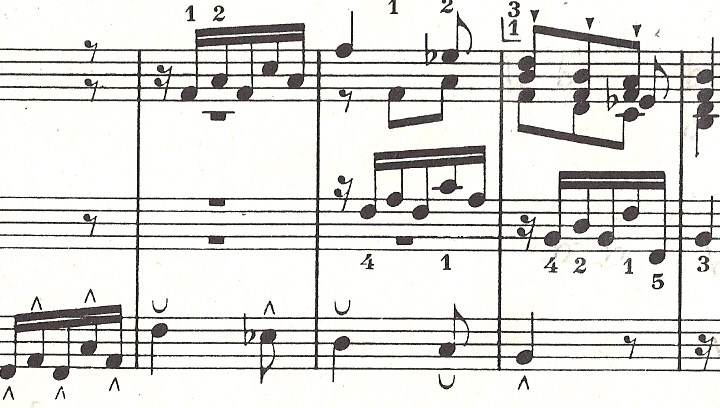
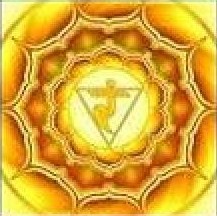
Chakra Three
(lustrous jewel)
Navel, solar plexus
Power, will
10 petals
Mars/Sun
1st liberating theme
3rd snake theme
We have entered a truly ambitious and liberating journey that will take us ever higher. We are climbing a "stairway to heaven" (to higher consciousness),
which has 7 steps. This confident new uplifting theme is repeated to open each succeeding chakra section (at the climactic 7th chakra the theme is given an
expanded and altered treatment). The liberating current becomes dominant as we go up the chakras, and likewise this uplifting theme becomes more dominant as we
go upward in the music. Already, in the opening two canons or snake themes, it had been suggested in the third measure (thus anticipating the third chakra), as the
principle notes of this uplifting, liberating theme were sounded there. It is also embedded in the pedal solos. But in the lower two chakras, the liberating theme is only suggested,
while the snake or "manifesting" theme is completely dominant, showing how the manifesting current is preeminent in the lower chakras. In the third, fourth and fifth sections,
however, the two themes alternate equally. But in the final and highest sections, the original manifesting snake theme becomes submerged and blended beneath the
uplifting liberating theme, now transformed into a fabulous crowning glory.
The grand chariot theme, which announces the third chakra, returns now during it, and returns once for each chakra from now on, usually
(as now) right after the liberating uplifting theme. The view is ever more scenic as we travel upward in our chariot. Then (in the yang chakras) the music makes a
difficult climb upward, as we practice and develop our spiritual powers.
Chakra Four
Then as the "uplifting" or liberating theme sounds again, we have entered the fourth chakra, the heart. We notice a difference this time from the previous section. The theme dangles around five times downward through different keys, as if moving more freely and gracefully (untied or "unstruck," the Hindu name of the chakra). There's less of the frantic ambition to move upward and onward that we heard in the previous third chakra. The themes are also played lower on the keyboard than in the previous and upcoming sections.
I long wondered why the heart chakra section features five repeats of the liberating theme, while the 3rd and 5th chakra sections have only four. The Da Vinci Code gave me the answer.
The pentacle (five-pointed star) is featured prominently as the symbol of Venus, the goddess of love and the sacred feminine. Brown pointed out that Venus passes closest to Earth exactly 5 times every 8 Earth years, about 1.6 years apart, after which it returns 8 years later to the same place in the zodiac. It also makes 5 backward rotations (like the downward shifting keys) on its own axis in 3.33 earth years, just over twice the golden ratio of 1.618.. Venus goes around the Sun 13 times in those 8 years, and 3, 5, 8 and 13 are fibonacci numbers (which reveal this golden ratio that shows up in many living things and natural phenomena as well as art and music). As you can see from our tables, Venus rules the heart chakra. These 5 repeats of the liberating theme
also matches the "5th element" (or ether, the quintessence), which I have linked to the heart. The uplifting theme is repeated only 4 times in the solar plexus and throat chakra sections of the toccata, representing the 4 elements, but here it is repeated 5 times, which signifies the presence of the 5th element in the heart chakra.
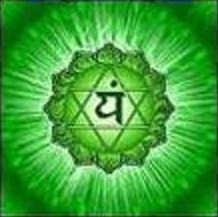
Chakra Four
(unstruck, innocent)
Heart
Love, guidance
12 petals
Venus/Moon & Saturn
2nd liberating theme
4th snake theme
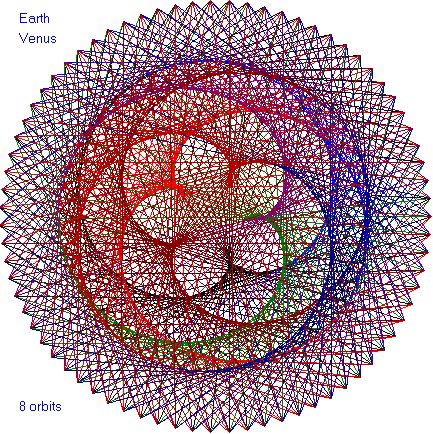
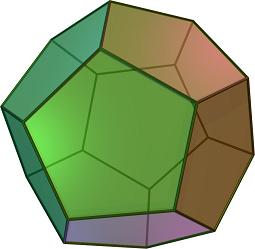
After the chariot theme, we jump up majestically an octave higher in bar 271 to hear the "crown" chords again, passionately announcing a new "heart-felt" and poignant phrase. This phrase also anticipates the crown chakra theme.
Chakra Five
The third-chakra’s "uplifting" and liberating theme then enters again to start the fifth section, and this time we sense greater urgency as we continue our
climb. We realize now we are in another yang or masculine chakra, the fifth or throat chakra. We can’t rest now; we are attacking the summit! We are ready for the most difficult challenges now, our great work is rising ever higher. So there’s no messing or whirling around with the liberating theme this time; the 4 themes all end on an upward tonic chord, as we move higher; and the tone is getting darker. Things are stated clearly and unambiguously, since this is the chakra of communication and purification. As we enter the chakra ruled by Mercury, or (in Greek) Hermes, the Magician himself, we feel about to be transformed by the magical work, and we face the dark demons within.
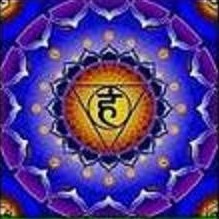
ChakraFive
(purification)
Throat
Expression
16 petals
Mercury
3rd liberating theme
5th snake theme
Chakra Six
Soon though, as the "uplifting" theme sounds again, we have entered into the sixth chakra section, at the brow or third eye. Suddenly a breakthrough occurs, as the entire landscape seems to stretch down before us. This is a visionary moment; we realize how high we have climbed! Revelations are occuring. The original snake theme and the 12-chord chariot theme are blended together in counterpoint, just as the yin and yang of our two eyes and two sides of our brain are united in our third eye. Our vision breaks through all barriers as we soar upward into the exalted key of B-Flat, the related major key to g minor, accompanied by Om-like bass pedal points. The music is graceful and poised again, since we are now in a yin chakra, and our chariot has carried us into the sattva level of higher consciousness. Once again, just like in the 2nd and 4th yin sections, the chariot theme ends on a peaceful tonic chord.
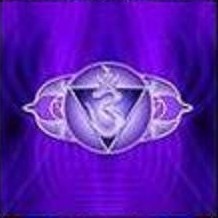
Chakra Six
(perceive, command)
3rd Eye
Vision, Intuition
2 petals
Moon/Jupiter
snake/chariot combined
Chakra Seven
Then the music readies us for the final leap.
The "uplifting" liberating theme enters again twice,
in two fragments, and then we are hurled exuberantly into the glorious final section.
A totally-transformed theme is sounded triumphantly over a huge new C-major Om-like pedal point. It is a simple theme crafted from all the
preceeding elements of the music, stretching and extending the 4 chords of the liberating theme. We feel the bliss in which everything
seems perfect, even if only for a moment. We have arrived at the radiant golden summit; the top of the head; the crown chakra!
Chakra Seven
(1000-petalled lotus)
crown of head
Spiritual Knowledge
1000 petals
Sun/Neptune
crown theme
The Fugue
Comparisons

Some other proposed traits and correspondences for the chakras
In astrology, planets not only "rule" two signs each, they are also "exalted" (or raised to their highest expression) in another sign.
This table shows how a planet exalted in a sign, helps determine the corresponding rainbow color of the chakra associated with it,
as well as further illuminates the traits of each chakra. In this table, notice that I have switched the positions of the elements air and ether from the most usual positions.
Since air is a yang element, and a symbol of intellect, I don't agree with correlating it with the heart, a yin chakra. Associating air instead with the 5th yang
chakra indicates its "sky blue" color, and air as the medium of communication. I correlate ether, space, or spirit, known as the 5th element or quint-essence,
that is central to the others, with the heart chakra, which is the center and authentic core of our being. I also include the highest, most spiritual elements
(fire/energy and spirit/thought) twice in the table, one each in yang and yin form.
chakra chakra trait signs exalted planet
polarity of chakra element color and source
Divine Science inherency of God
Fillmore's 12 soul powers
virtue/tarot
7-crown connection to God Leo Neptune (the mystic) yang spirit as yang (thought or Mind)
Neptune = violet wisdom Leo = wisdom
Wisdom/
World
6-third eye visionary Cancer Jupiter (higher mind, prophecy) yin fire as yin (light)
Jupiter = blue violet knowledge
Cancer = imagination Hope/
Star
5-throat purification, expression Virgo, Gemini Mercury in Virgo yang air (gas)
air = sky blue understanding
Virgo = understanding, Gemini = power of word
Temperance
4-heart love, center of being Libra, Taurus Saturn in Libra, Moon in Taurus (justice and mercy)
yin spirit as yin (ether, central 5th element)
Saturn = green love
Libra = order, Taurus = love
Justice
3-navel/solar plexus will, coordinated energy Scorpio, Aries Sun in Aries (conscious will) yang fire as yang (energy)
Sun = yellow power Scorpio = strength, Aries = will
Strength
2-genitals/lower stomach sensual, joyous Sagittarius, Pisces Venus in Pisces (sensuality) yin water (liquid)
Venus = orange-yellow joy Sagittarius = zeal, Pisces = faith
Love/
Lovers
1-base grounding, survival-oriented Capricorn, Aquarius Mars in Capricorn (initiative) yang earth (solid)
Mars = red life Capricorn = life, Aquarius = release
Faith/Fool
click on watch in you tube above
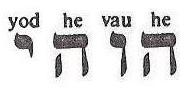

Each note, of course, is preceeded by the same high A note (at the dominant), creating "oneness" through the theme. This theme is the basis for everything in this
great Toccata and Fugue in D Minor, which is also known as "Phantom of the Opera" and is said to have been Bach's symbol for a cosmic storm. It is a mainstay of the
Bewitched Genre of music, and the cross with the four directions is used in many pagan, occult and
shamanic traditions, as well as being a symbol of Christianity and "the throne of God" (c.f. The World tarot card below)
Toccata in F by J.S. Bach BWV 540 is not the only music based on the chakras and/or 7 levels.
Here is a list of other pieces of chakra music, with some links
The Tarot Triumph and Bach's Toccata in F: more thoughts
The tarot is a set of 78 playing cards designed in the Renaissance in Italy and France to play a game that is the forerunner of bridge.
Like a regular deck, it has 4 suits of 10 cards each, plus 4 kinds of royal face cards instead of 3 (usually the King, Queen, Knight and Page).
Plus it has 22 extra cards (the 5th suit) called trump cards, numbered 1 to 21, with an extra wild card. Nowadays in bridge, one of the regular suits is
designated the trump suit, but originally it was a separate suit. By painting images on them, Renaissance artists used these trump cards numbered from 1 to 21
to tell a mythical spiritual story, based on the neo-Platonic mystical philosophy that fascinated people at the time. Since 1781 occultists, magicians and
fortune tellers have used tarot cards as tools to guide us on our own spiritual journey.
.jpg)
Remember, the 100-year old Golden Dawn tarot tradition is not as venerable as the actual tarot tradition that stems from the
Renaissance, about which the Golden Dawn apparently knew little. So there is nothing wrong with making changes to it. Even Arthur Edward Waite,
co-creator of the first modern tarot deck, and a Golden Dawn member, said that "the wrong stories have been told about the tarot."
As Joseph Campbell has pointed out, most of the great myths and stories of the world refer symbolically to OUR personal spiritual journey, more than to God's.
They are about your inner demons,
your quest for liberation, the lessons you need to be a whole person. Clearly the Tree of Life is one of these significant mystic symbols and stories.
Yet the Golden Dawn tradition numbers the 22 pathways on the Tree from the top down, as if they are the path God takes.
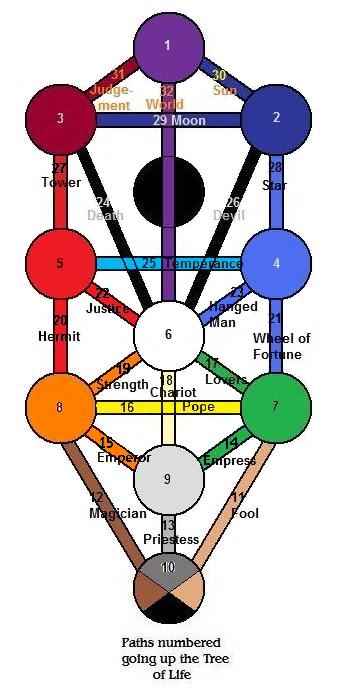
At right is an earlier version of the Tree to mine with the path positions reversed, by Frater Achad in 1923,
although the tarot sequence is a bit jumbled. Aleister Crowley evidently referred to this version by denouncing it in his book
Magick in Theory and Practice (p.7). But this is precedent for the alternative view to the more popular one. Kudos to D.A.R.V. for referring me to this Tree.
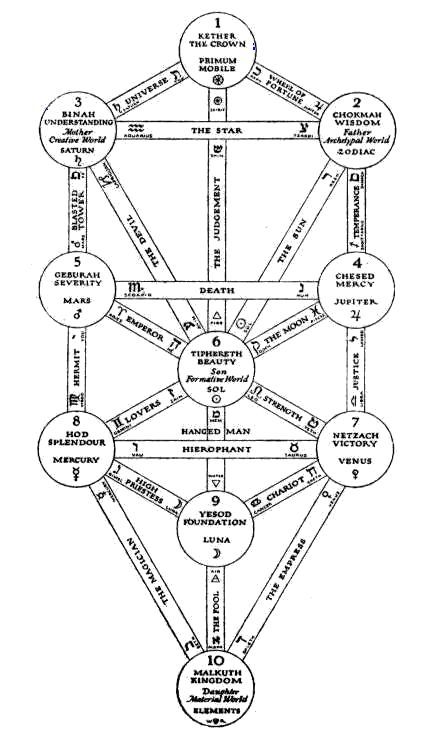
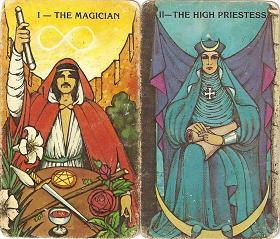
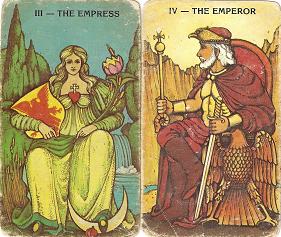
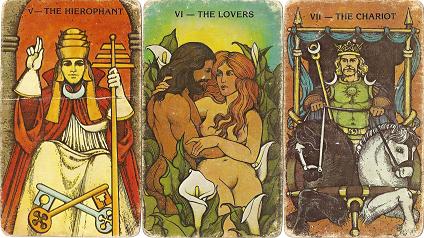
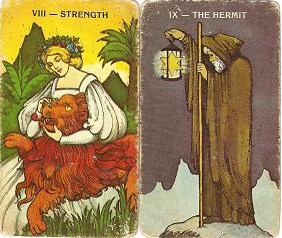
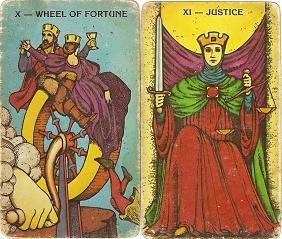
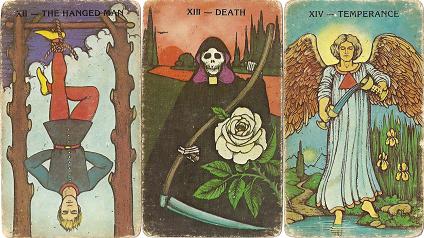
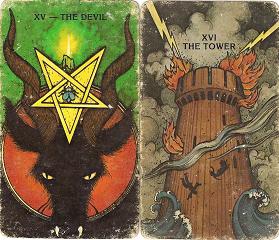
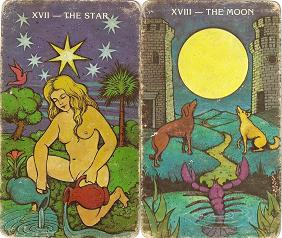
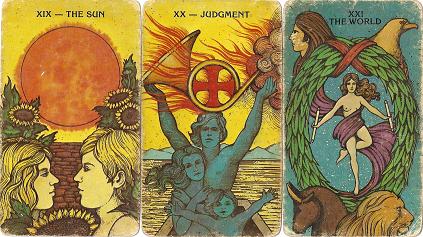
Here is a table of the 7 levels and 3 parts of the soul, listed from the highest:
3 parts of soul: Plato Kabbalah Hindu gunas Freud's psychology
metaphysics chakra Toccata in F section
tone color
metal planet Tree of Life
reason/wisdom Neshemah sattvas super-ego super-conscious 7=crown synthesis: crown theme B
violet/purple gold The Sun Kether (crown)
reason/wisdom Neshemah sattvas super-ego super-conscious 6=3rd eye synthesis: breakthrough A
indigo silver The Moon Hokmah (wisdom) & Binah (understanding)
passion/will Ruah rajas ego conscious 5=throat uplifting chords, urgent and clear G
blue mercury Mercury Hesod (mercy) & Gevurah (severity)
passion/will Ruah rajas/sattvas ego conscious 4=heart uplifting chords, calm and centered
F green copper Venus Tipareth (beauty)
passion/will Ruah rajas ego conscious 3=navel uplifting chords, strong and fiery E
yellow iron Mars Netzah (victory) & Hod (glory)
appetite/worldly Nefesh tamas id sub-conscious 2=sacrum joyous canon, left hand leads
D orange tin Jupiter Yesod (foundation)
appetite/worldly Nefesh tamas id sub-conscious
1=base joyous canon, right hand leads C red lead Saturn
Malkuth (kingdom)
0. aleph = ox
1. beth = house
2. gimel = camel
3. daleth = door
4. heh = window
5. vav = nail
6. zain = sword
7. cheth = fence

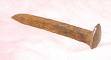
In the first group, from aleph to cheth, we see no less than five letters that mean a house and parts thereof: house, door, window,
nail (or hook) and fence. Two of the other letters represent heavy beasts of burden: the ox (or bull) and the camel. The remaining letter stands for a weapon
used to defend all this property, the sword. The first group of letters represents worldly concerns: the need to survive and prosper in the world by building and
defending a physical house and a yard (the "Emperor's domain"), and using beasts of burden there to meet your needs. They thus could not correctly coincide
with the upper three sephiroth that represent knowledge of God, God the Father in heaven, and the great Mother goddess of celestial love and understanding!
Instead they correspond with Malkuth the worldly kingdom, with life’s Foundation or fertility, its sensuous Splendour, and its Victory (perhaps victory in fending off
threats to worldly acquisition): the lower four sephiroth.
8. teth = serpent
9. yod = open hand
10. kaph = closed hand
11. lamed = ox goad
12. mem = water
13. nun = fish
14. samekh = tent peg




In the second group from teth to samekh, which would coincide
with the middle sephiroth whichever direction (moving up or down the Tree) is chosen, we see another interesting fact. Two of the letters represent the human hand.
The occultists seemed to have forgotten Adam Kadmon. This is the kabalistic doctrine that the tree of life aligns with the perfect Man-- Adam-- and symbolically
with the human body of everyone. If this is so, then the middle group of Hebrew letters should have symbols for the hands in the middle of the body. It also contains
two symbols for tools used by the hands; an ox goad, and a tent peg-- linked to the virtue cards Justice and Temperance respectively. The peg or prop indicates
that we are less focused on permanent shelter and security in the world and more willing to "camp out" and thus adapt, move and grow (and "adaptation" is what
the word Temperance, linked to this symbol, originally meant). This middle section also contains two animals, like the first; but they are not beasts of burden,
but symbols of powers or "virtues" in the human soul: the serpent (representing Strength) and the fish (representing Death, or the ability to swim with the currents of change).
Finally there is water, a symbol of passion often associated with the heart, the center of our being. Water is in the middle of the elements too; less stable than earth,
but more substantial than air and fire.
15. ain = eye
16. pe = mouth
17. tzaddi = fish hook
18. qoph = back of head
19. resh = head
20. shin = tooth
21. tav = cross


In the third group, from ayin to tav, the correspondence with Adam Kadmon is made crystal clear. No less than five of the seven letters
are named after parts of the human head: eye, mouth, back of head, front of head, and tooth. The head is the seat of the higher chakras, and thus
the spiritual parts of the soul. This is known to all occultists, and yet they link these letters to the groin, the genitals and the stomach! The
other two symbols are a fish hook, the means of spiritual discovery within the sea of life; and the cross of the 4 elements, which symbolizes the throne (or crown)
of God, linked to The World card where this throne is pictured; and also to the cross of the death, resurrection and ascension of Jesus the Christ.
Here is a table showing how BOTA lined up 12 Tarot cards, zodiac signs and Hebrew letters with 12 colors and tones,
verifying that in fact the cards and letters reveal a journey UP the chakras and soul levels.
Tarot trump Hebrew letter Zodiac sign color spectrum tone
chakra soul level Moon Qoph=back of head Pisces red violet B 6 or 7 Reason Star Tzaddi=fish hook Aquarius violet A# 6 or 7 Reason Devil Ayin=eye Capricorn blue violet A 6 Reason Temperance Samekh=prop Sagittarius blue G# 5 Will Death Nun=fish Scorpio blue green G 5 Will Justice Lamed=ox goad Libra green F# 4 Will Hermit Yod=open hand Virgo yellow green F 3 or 4 Will Strength Teth=serpent Leo yellow E 3 Will Chariot Cheth=fence Cancer orange yellow D# 2 Appetite Lovers Zain=sword Gemini orange D 2 Appetite Hierophant Vav=hook Taurus red orange C# 1 Appetite Emperor Heh=window Aries red C 1 Appetite 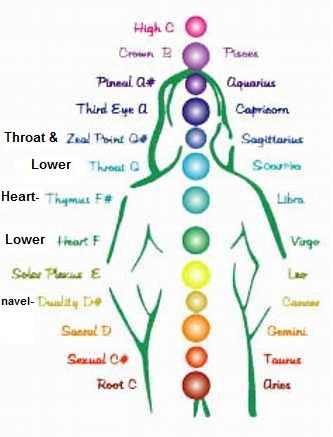
For those interested in a more detailed correlation of the 12 notes, colors and signs with the 12 chakras (7 major and 5 minor) along the spine, as they are
depicted in the picture above
(posted on flickr by Jai MA),
see this footnote.
No doubt the allegory in the Tarot trumps or Major Arcana might need
some updating: see Footnote (because we don’t live in Renaissance times....)
Trumps and Toccata
Remember you can hear
Switch between tabs and use the pause button at You Tube when you want to stop the music.
Soul of Appetite
(worldly, sensual, joyous; beginning phase of spiritual hero's journey: worship)
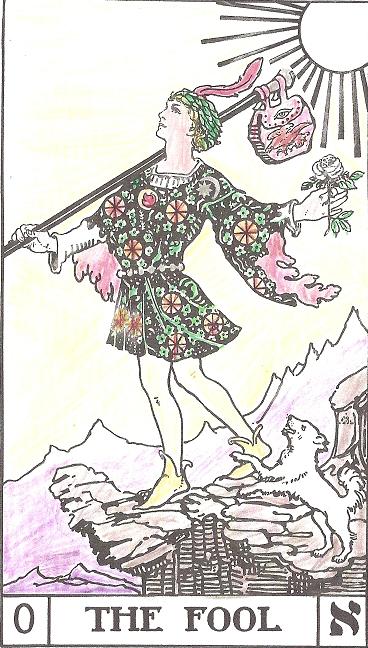
That the figure has three chords could represent the three parts of the soul that we all have. It comes at the end, which also can become the beginning too if you
start the Toccata over again. In that way it introduces
the first canon, just as it later introduces the second. Since the Fool and its number zero represents what precedes all manifestation, you could say that the chord
preceeding the toccata is inaudible and "unmanifest"-- unless you start the music over from the end. So the Fool’s journey also involves reconnecting with his beginnings,
and his discovery that "in my end is my beginning" or that eternity has "ended before the beginning." The Fool's place at the end and (unmanifest) at the
beginning of the Toccata thus also represents the principle, upheld by many, that manifesting any goal happens by imagining "by faith" that it is "already done"
from the end. Thus we can also say that the Fool's virtue, Faith, is found at the top of the scale (and in the head), as well as coiled at the base (as shown in my tables here).
It is the ouroboros principle.
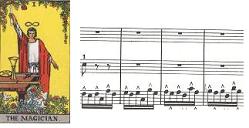
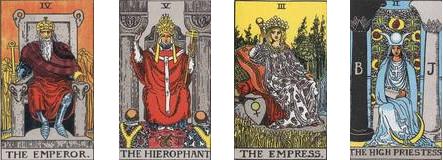
7.World/Wisdom = Pisces,
6.Star/Hope = Aquarius,
5.Temperance = Sagittarius,
4.Justice = Libra,
3.Strength = Leo,
2.Lovers/Love = Gemini,
1.Fool/Faith = Aries.
Soul Level Trump# Tarot/Virtue Hebrew letter Golden Dawn
Virtue Chakra Reason 21 World/Wisdom tav=cross Saturn Pisces=Wisdom 7.Leo/Neptune Reason 20 Judgement shin=tooth fire/Pluto
Pluto 7.Leo/Neptune Reason 19 Sun resh=front of head Sun Sun 6/7.Leo Reason 18 Moon qoph=back of head Pisces Moon 6.Cancer/Jupiter Reason 17 Star/Hope tzaddi=fish hook Aquarius Aquarius=Hope 6.Cancer/Jupiter Reason 16 Tower peh=mouth Mars Uranus 6.Cancer Reason 15 Devil ayin=eye Capricorn Capricorn 5.Virgo/Mercury Will 14 Temperance samekh=tent peg Sagittarius Sagittarius=Temperance
5.Gemini Will 13 Death nun=fish Scorpio Scorpio 5.Virgo Will 12 Hanged Man mem=water
water/Neptune Neptune 4.Taurus/Moon Will 11 Justice lamed=ox goad Libra Libra=Justice 4.Libra/Saturn Will 10 Wheel of Fortune kaph=closed hand Jupiter Saturn 3.Scorpio Will 9 Hermit yod=open hand Virgo Virgo 3.Scorpio Will 8 Strength teth=serpent Leo Leo=Strength 3.Aries/Sun Appetite 7 Chariot cheth=fence Cancer
Cancer 2/3.Sagittarius Appetite 6 Lovers/Love zain=sword Gemini
Gemini=Love 2.Sagittarius Appetite 5 Pope vav=nail Taurus
Jupiter 1.Capricorn/Mars Appetite 4 Emperor heh=window Aries
Mars 1.Capricorn/Mars Appetite 3 Empress daleth=door Venus
Venus 2.Pisces/Venus Appetite 2 Priestess gimel=camel Moon
Taurus 2.Pisces/Venus Appetite 1 Magician beth=house Mercury Mercury 1.Aquarius 0 Fool/Faith aleph=ox air/Uranus Aries=Faith 1.Aquarius
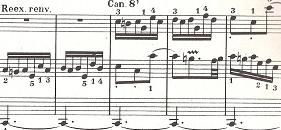
Wow; even the letters J and B are used in tarot cards and masonic rituals to represent the male and female forces (Joachim/Jakin and Boaz, often pictured
on the High Priestess card, representing columns in front of
Solomon's Temple, I Kings 7:21), and the S becomes the uniting pillar and pedal note in the center! J for Johann and B for Bach also refer to J and P from the
MBTI Jungian personality test, and to I and P or Ida and Pingala from kundalini (in this case with the polarity reversed). "S" for Sebastian of course also stands for
Sushumna, spine, spiral, spirit, snake, serpent, Shakti, Shekinah, Solomon, the S curve between yin and yang, etc.. The two columns are often pictured as white (J) for male/yang, and black (B) for female/yin.
Sometimes (as in The DaVinci Code), this is reversed too. The cross in the center (and at the heart chakra) of the Priestess card is called the "Solar Cross;"
representing the cross formed by the Sun's two movements in the sky: yearly (from north to south and back), and daily (from east to west). If S stands for "Solar Cross,"
then reading on the Priestess card-- in reverse direction, like the 2nd canon & 2nd chakra connected to this card, from right to left-- we see J S B for
Johann Sebastian Bach. That's quite a sign that Bach was connected to these cosmic patterns.
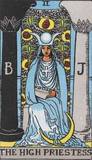
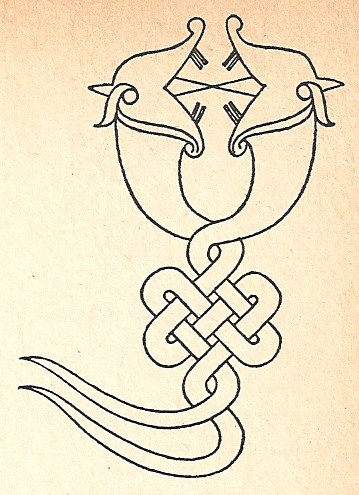
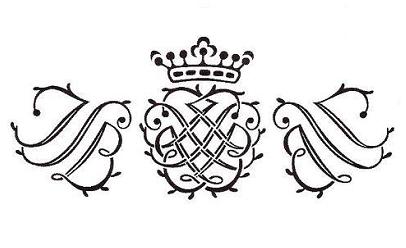
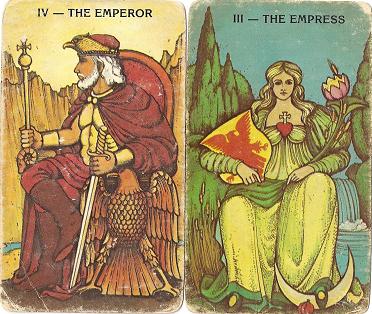
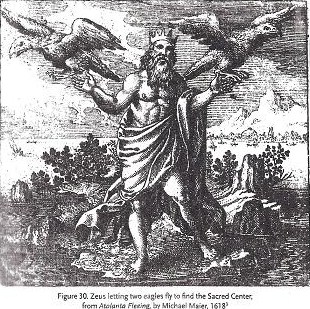
Imperial Tarot cards #1-5 Emperor Pope/High Priest Magician Empress Papess/High Priestess
Bach Toccata in F portion first canon pt.1 first canon pt.2 first pedal solo second canon pt.1 second canon pt.2
*Bach's seal; corresponding symbols; see above Eagle facing East = J = Johann, Joachim, Judging S = Sebastian, Solomon, Sushumna
Eagle facing West = B = Bach, Boaz, Perceiving
*Jungian Function thinking intuition (archetypal knowledge) individuation sensation feeling (psychic, subconscious, esoteric, empathic knowledge)
*philosophy circle rationalism essentialism spiritualism manifest empiricism existentialism
Element air fire spirit earth water
Weather dry hot alive cold wet
Cardinal Direction East Up/South (or North) Center Down/North (or South) West
*Quadrant lower east upper east center lower west upper west
Tarot suit swords wands trumps coins/pentacles cups
MBTI Type NT NF integrated ST SF
*Court cards knights kings imperial cards pages queens
*Evangelist Matthew Mark Jesus Luke John (or Mary Magdaline)
*Symbolic Creature Man/Angel Lion Lady Sophia on World card Bull Eagle
*Zodiac Sign Aquarius Leo anima mundi Taurus Scorpio
*Geometry octahedron tetrahedron dodecahedron cube icosahedron
*Social Class Noble Priest Saint/outcast Merchant Peasant/Worker
Social Archetype Teacher/King Visionary/Priest the integrated person Warrior Healer/Lover
Generation type Civic Hero Idealistic Prophet society as a whole Reactive Nomad Adaptive Artist
*Color Wheel orange red
purple/yellow green blue
*Sephiroth Glory (Hod) Severity (Geburah) Beauty (Tipareth) Victory (Netzach) Mercy (Chesed)
Of course, in some other schemes these and other correspondences may not all line up in the same way. The 4 Directions, and 4 Seasons (included in the signs/kundalini
table above), can be switched around, for example. The 4 seasons are shown in order on the tarot's World card by the positions of the 4 figures surrounding the Lady. I present and discuss a table with correspondences to this seasonal order in a footnote on the links page. However, please note: in the original revelation of the 4 figures around the throne of God at Ezekiel 1:10, the faces of the figures are presented in toccata order, not seasonal order!
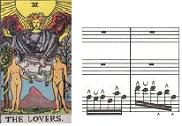
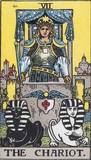
Soul of Will
(passion, cultivating virtue, dealing with reality of time and fate; middle phase of spiritual hero's journey: study and practice)
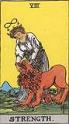
After hearing the Chariot theme for the first time, we begin our conscious struggle for liberation by discovering our virtue of Strength (a woman taming a lion), and there’s no better symbol of it than this fiery upward arpeggio (the uplifting theme). It is repeated here four times in succession, "boldly" moving through 4 different keys; the first two ending on an upward note, and the last two on a downward note. This shows how strength is really receptive as well as assertive. We need to arouse the fire in our belly (3rd chakra) and strengthen our will to make this journey! The elemental (or cardinal) number four dominates each virtue theme (Strength, Justice and Temperance). Each theme is 4 bars long. Each time the pedal sounds the theme first, then it is imitated three times, once by the right hand and two by the left (thus 4 times in all), showing that the spiral snake energy is continuing. Four more strong notes in the pedal climb downward, supporting the hands.
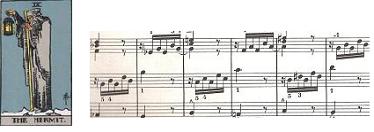
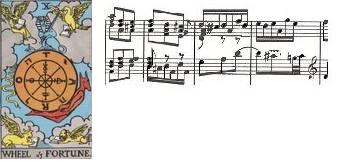
Then we hear the most powerful chords of the entire Toccata,
representing the great Wheel of Fortune. It indeed sounds like some great wheel in motion. These chords stand for the eight spokes of the great Wheel (these 7 chords can be considered as two succeeding groups of 4 big chords, with the last chord of the first group also serving as the first note of the second group). This is the 4-note "world chord", about which more later. Another interesting coincidence is that in Kevin Kendle's new age music work on The Tarot, his theme for Wheel of Fortune is the same as these chords in Bach's Toccata in F.
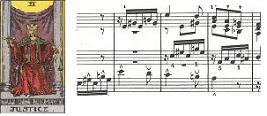
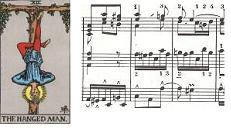
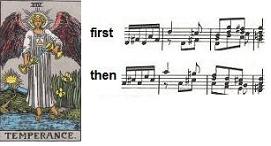
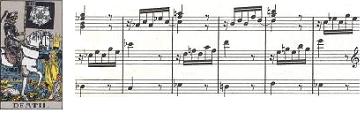
Then Death (the grim reaper) is represented by the same anxious phrase (the climbing or struggle theme, see left) that represented the ascetic Hermit card in the third section. Clearly there is a similarity here between the suffering of the Hermit and the suffering of Death. By facing Death, the seeker has taken the Hermit’s quest further. Indeed, the Hermit is an "old man" (originally Father Time), perhaps on the verge of death, like the old man the Buddha saw outside his palace when he was a prince. The second time we hear it, this "struggle theme" and the sharp, dissonant "inversion" chord it begins with, sounds more startling and suspenseful by being played much higher on the keyboard (literally "taking the quest further" by starting one note higher than the last notes of The Hermit's theme). Both Death and the old Hermit are symbols of the seeker's struggle with time and its limitations.
Soul of Reason
(wisdom, final liberation, climbing the ladder to heaven; final phase of the hero's journey: spiritual unfoldment, experience of enlightenment, bliss and return)
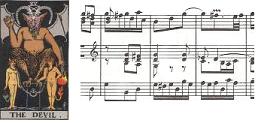
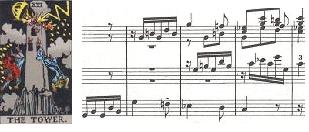
Then the battle is won. We hear the liberation theme one last time, sounding like it did at the start of the third section. As before, it announces we have entered the next chakra, the 6th or 3rd eye. This time it's the The Tower, from which the Devil, and the lower souls chained to him, fall as lightning strikes. We are being freed, and the liberating theme symbolizes this moment. Prudence or Wisdom, the 4th cardinal virtue, comes later. But this section, played higher on the keyboard than others (like a high tower), shows the high place we have reached in our journey. This time the theme only needs to be heard 3 times instead of 4 or 5 (for the 3 now-developed virtues; all contained within the final virtue Wisdom). The three "Fool chords" which conclude each repeat of the liberating theme,
are all heard here in the higher octave as we reach the 6th chakra. By contrast, only two of the triple Fool chords in the 5th chakra Temperance section were heard an octave higher (out of 4 total repeats of the theme), and fewer with the earlier virtues-- once in the heart chakra (Justice), and none in the solar plexus (Strength). This time the middle chord goes highest, like the lighting strike from above. The other chords are the 2 figures falling.
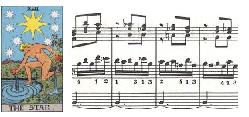
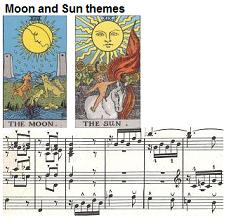
Next, the chariot theme is repeated again-- this time alone without the snake. This corresponds to The Moon card. It sounds calm, scenic and restful, as we prepare for the last part of our journey. According to Robert Place, "we are entering on the path that leads to the dawn but the Moon is there now. It is a time to rest and to prepare." (The Tarot, p.209)
The Sun’s section follows immediately after the Moon, and there’s no doubt about this correlation. It even comes in two parts, two fragments of the liberating theme; representing the two young children (or child and horse) on the card, also indicating the divine marriage of male and female (similar to the Lovers card, some say, which is linked to Gemini the Twins). It means we are ready for final liberation. Following Plato, the Sun card represents enlightenment; the real light outside the cave. It is a victorious, radiant moment, but the victors are leaving the garden and moving on to an even greater illumination (Place, p. 210; Case, p.194-95). That is exactly how the music sounds; very radiant, powerfully liberating;
yet clearly introducing the next section, which is the Toccata’s crowning glory. Or as Lionel Rogg called it, the culmination.
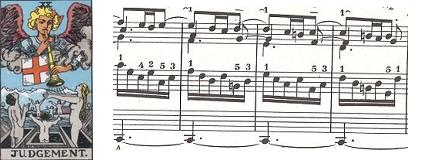
Bach then brought back "the struggle theme" from the middle of the 3rd and 5th sections, which was omitted in the 4th or heart section, and inserted it here in the 7th as a recapitulation/coda to conclude the Toccata, and so
it represents The World or Universe card, the highest trump, symbol of the mystical goal of the journey: identification with The Universe, and Nirvana. This reveals the ultimate state of consciousness as a link between the crown and the heart. It combines, as said before, the Toccata’s two themes, both liberating and manifesting, one after the other, passionately transformed; thus representing the whole journey. This also ties The World to Death and The Hermit, where the same theme is heard. This theme's link to these 3 cards indicates that Nirvana is essentially the
same as the struggle and climb within the world of time represented by Death and the old Hermit; perhaps you can't have one without the other. And it is by transforming Death that we realize immortality. We become grateful dead. The Spirit is everywhere, including in all our struggles; it is the whole journey, and knowing this IS real liberation. We become the journey-- and the World. Before enlightenment, chop wood and carry water. After enlightenment, chop wood and carry water.
Like a bodhisattva, we return to the struggles of life until every sentient being is enlightened. We go back into Plato's cave to bring light to the captives. Even the Hermit, in the midst of his own quest, helped light the way for others. Now the enlightened Master does the same. THAT is why Bach uses the same passage to represent both the highest consciousness, the goal of the journey (World)--- AND the hardest lessons, deepest struggles and darkest abyss during the journey itself (The Hermit and Death).
*In these cases the 4 notes/chords are exactly the same as the 4 final note/chords. In the other cases, the first of the 4 notes is up to 2 tones higher.
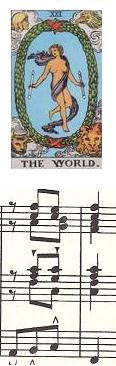
Because the Toccata's final (and recurring) series of 4 chords, or a note followed by 3 chords, moves from high notes to middle to low to middle, it also resembles the 4-letter word YHVH, yod heh vau heh, the tetragrammaton, which is the sacred Hebrew name of God--
and often linked to the four elements, four directions, four evangelists, four fixed signs, four tarot suits, four creatures (or angels) from the throne of God, etc. As we saw, YHVH is also implied by the theme of Bach's other great Toccata and Fugue, the famous one in D Minor S.565.
This theme (the "fugue" theme) is composed of 4 sections of 4 notes each (in counterpoint to a repeated dominant note). The first 4 notes come down the scale, sort of like a Y. An ascending 4 note sequence follows (H), and then four notes come up the scale from below, sort of like V. The last 4 notes of the great theme are the same as the second four-- thus the second H. By coincidence, in English the letter H stands for horizontal, and V for vertical, indicating the 4 directions of the cross and the medicine wheel. The numbers in kabbalistic gematria for the Hebrew letters heh vau heh are 565. Plus, S for Schmeider in English is the 19th letter, and 1+9 = 10.
See my You Tube video showing the correspondence of Tarot trumps to the Toccata, with exact timing!
TABLE: The Tarot Triumph and correlations with 3 parts of soul, chakras, Toccata in F, etc
based on The Tarot by
Robert M. Place
3 Parts of the Soul Trump Card chakra meanings,notes Toccata in F section
Soul of Reason World 7=wisdom prudence,world soul, sophia coda; struggle ends
(wisdom) Judgement 7 resurrection, goal of mystics crown theme, synthesis
The Sun 6/7 3 lights are the time keepers;
intro to crown
The Moon 6=light,insight we climb the ladder of planets. chariot theme alone, restful
The Star 6 seeks harmony of wet and dry
chariot w/snake theme
The Tower 6 liberation from our lower souls
final liberation theme
The Devil 5=purification, last hurdle of temptation darkest manif.(snake) theme
Soul of Will, Temperance 5 communication. lower virtue, placed highest 3rd liberation theme
and Passion; Death 5 facing the abyss struggle theme (reversed w/above)
time and fate Hanged Man 4=love, balance initiation, sacrifice, openness downward manif. theme, more lyrical
Justice 4 virtue of proper ordering calmer, 2nd liberation theme
Wheel of Fortune 3=will,power prosperity, fate, ups and downs downward manifesting(snake) theme
The Hermit 3 time; the seeker, ascetic struggle, climbing theme
Strength 3 heroic virtue powerful 1st statement of liberation theme
Soul of Appetite; Chariot 2/3 love as driving force, now in control 2 chords & pedal; repeated in each chakra above
sensuality, Lovers 2=joy,desire love as conscious choice 2nd pedal theme, up & down
worldly power Hierophant(Pope) 1=life,survival sacred male worldly ruler 1st snake canon, 2nd half
Emperor 1 male worldly ruler 1st snake canon, 1st half
Empress 2 female worldly ruler 2nd snake canon, 1st half
High Priestess 2 sacred female worldly ruler 2nd snake canon, 2nd half
Magician 1 trickster, guide 1st pedal theme, downward
Fool 1/7 outsider, performer, everyman basic 3 chords at end, or start
Soul level Toccata themes Tarot cards Exalted Planet Yang Sign Planet,Chakra Yin Sign Exalted Planet
Tarot cards Toccata themes Soul level Reason liberation 5 (extended),chariot Sun,Judgement Neptune Leo Sun,
7 World climbing theme, chord Reason Reason liberation 4; chariot/snake Tower,Star Moon,6
Cancer Jupiter Moon chariot Reason Will liberation 3, chariot Temperance Gemini Mercury,5 Virgo Mercury Death, Devil climbing theme, snake 5 Will, Reason Will liberation 2, chariot Justice Saturn Libra Venus,4
Taurus Moon Hanged Man snake 4 Will Will liberation 1, chariot Strength Sun Aries Mars,
3 Scorpio Hermit, Wheel of Fortune climbing theme, snake 3 Will Appetite pedal 2; chariot Lovers,Chariot Sagittarius Jupiter,2
Pisces Venus Empress,Priestess snake 2 Appetite Appetite pedal 1; chord Magician,Fool Aquarius Saturn,1
Capricorn Mars Emperor,Pope snake 1 Appetite
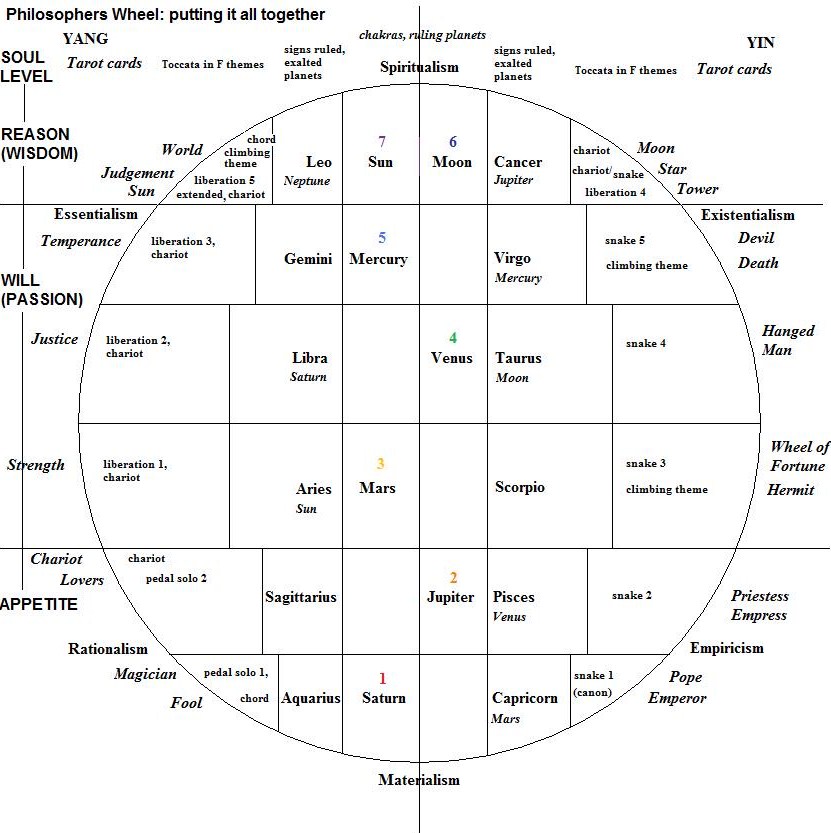
Virtue tarot cards, chakras, toccata
I have shown in my table above that the traditional 7 virtues (the 4 cardinal virtues of Plato, plus the 3 Christian virtues from St. Paul) are all found in the tarot; either explicitly (Strength, Justice, Temperance) or implicitly (Wisdom, Faith, Hope, Love). The soul develops these virtues (or they are given by grace or by female companions) on the path to liberation. Each chakra has a virtue, and thus so does each level on the "ladder to heaven." Therefore, each of the 7 chakra sections of the Toccata in F represents a virtue. The tarot card for each virtue not only has its own section in the toccata, but also shares rulership over an entire chakra section. So here is a table showing the 7 chakras, 7 virtues and 7 sections of Bach's Toccata in F:
Chakra Seven
Liberation theme 5, extended; chariot;
climbing theme
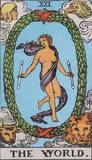
Chakra Six
Liberating theme 4,
chariot/sixth canon-snake;
chariot
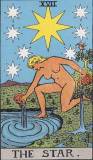
Chakra Five
Liberating theme 3, chariot;
climbing theme;
Fifth canon-snake, with pedals
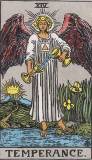
Chakra Four
Liberating theme 2, chariot;
Fourth canon-snake, with pedals
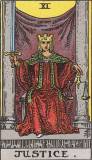
Chakra Three
Liberating theme 1, chariot;
climbing theme;
Third canon-snake, with pedals (trio)
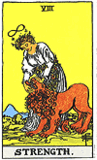
Chakra Two
Second canon-snake;
Second pedal solo;
chariot (transition to chakra 3)
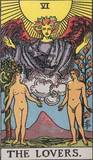
Chakra One
First canon (snake theme);
First pedal solo
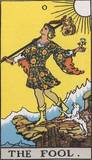
Bach didn't base his Toccata in F or other organ works directly on the Tarot cards, but he may have had some knowledge of esoteric philosophy and alchemy, as his seal and his personal library indicate. The sequence of the Toccata in F teaches us even more than the cards alone. Just as images say more than words, so does music. We see here a correspondence, a similarity, even in great detail, between two great examples in the arts representing the hero's mystical journey. I think that's beautiful to behold.
Comments welcome!